Artificial Biological Intelligence w/ Adrian Woolfson
BONUS | World Governments Summit #01
Listen on Apple Podcasts | Spotify | YouTube | SoundCloud | Goodpods | CastBox | RSS Feed
Bonus episode recorded live from the World Governments Summit at the House of Impact on 03 February 2026.
Summary
Geneticist Adrian Woolfson shares his insights on designing life with artificial biological intelligence, the possibility of creating new species, and the responsibility that comes with rewriting the rules of evolution.
Guest Bio
Adrian Woolfson is the co-founder of Genyro, a California-based biotechnology company specialising in synthetic genome design and construction. Born in London, he studied medicine at Balliol College, Oxford, and was formerly the Charles and Katherine Darwin Research Fellow at Darwin College, Cambridge, working at the MRC Laboratory of Molecular Biology. He is the author of the critically acclaimed Life Without Genes: The History and Future of Genomes and An Intelligent Person’s Guide to Genetics. He has authored over 160 scientific papers, book chapters, reviews, and patents, and is a regular contributor to the Wall Street Journal and Science magazine.
Featured Book
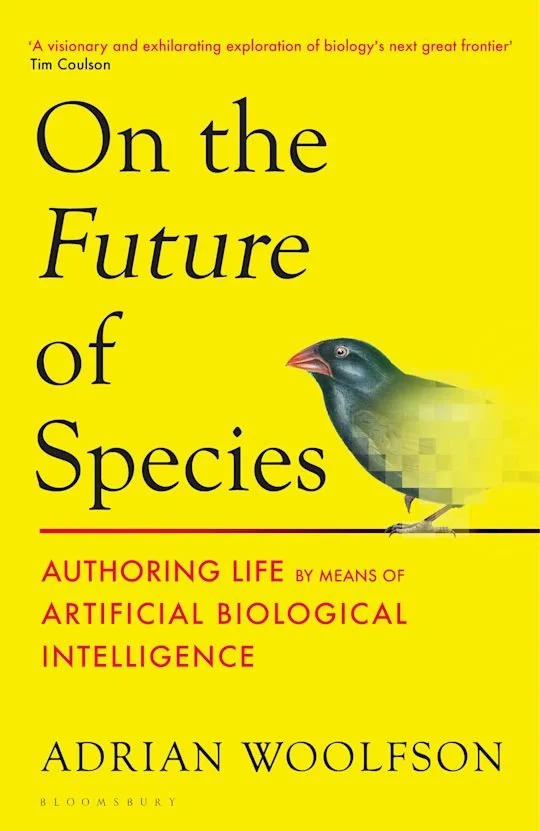
Imagine a future where we grow houses rather than build them. Where smartphones are living, clothing has opinions, and all human knowledge fits into a speck of DNA. A world where disease is a thing of the past, and the human lifespan is dramatically extended.
To achieve this, says Adrian Woolfson – founder of the genome writing company Genyro – we must transform biology into a predictive, programmable engineering material. That means decoding the generative grammar of DNA: the language of life itself. It may then be possible to author genomes – and, if we choose, even rewrite our own.
We are at the cusp of a technological revolution, driven by the convergence of artificial intelligence and synthetic biology. Currently at the scribbling phase – writing the genomes of viruses, bacteria and yeast – we will eventually author the genomes of extinct and never-before-realised species. Life will become computable, detached from its past, and no longer bound by Darwinian evolution.
While offering extraordinary opportunities, this power also carries great risk and it is vital for everyone to understand what the future might hold. Genome writing can help preserve the planet, but may also undermine human nature and disrupt ecosystems. Bold, visionary and deeply original, On the Future of Species is an essential guide to how we should navigate this astonishing new world, offering a moral compass to help us do so safely, wisely and ethically.
Find out more
Transcript (AI-Generated)
NOTE: This transcript is AI-generated and unedited. It may contain errors. A human-transcription is coming soon.
Luke Robert Mason: You are listening to The Futures Podcast live from the World Governments Summit. On this show, we meet the scientists, technologists, artists, and philosophers, working to imagine the sorts of developments that might dramatically alter what it means to be human. Some of their predictions will be preferable, others might seem impossible, but none of them are inevitable.
My name is Luke Robert Mason, and I'm your host. When we think about the emergence of life, we usually imagine a process shaped by evolution, by chance, mutations and natural selection unfolding over a millennia. But what happens when we move from observing life to authoring it from biology, being a descriptive science to a predictive engineering discipline.
Can. New technologies such as artificial intelligence combined with large scale genome synthesis, allow us to generate and construct entirely new possibilities for life. Exploring these many questions is my guest today, Adrian Wolfson, author of the new book On the Future of Species. He claims that we may soon be able to author life through harnessing artificial biological intelligence or a BI to reshape agriculture, industry medicine and ultimately what it means to be human.
So Adrian, welcome to the Futures Podcast.
Adrian Woolfson: Thank you, Luke.
Luke Robert Mason: So I wanna go back through the history first and, and unpack this concept that you used so wonderfully in the Book of Life. Your book tells us a story of how we came to deal with the understanding of that living species are not fixed and they.
Flawless and they're not inflexible. But in actual fact, in the 18th century, we found out that we are very changeable. So how has that changed our understanding of life and the opportunity it provides us in the 21st century?
Adrian Woolfson: So if we, if we go back obviously to some of the, uh, earlier. Notions of how life began and what it was starting with Cicero, actually the idea was that obviously we were created.
Right? And, um, eu, for example, in the, uh, beginning of his book, uh, has a, as a drawing of, um, him sitting in the Garden of Eden, dispen liberally dispensing the names of new species, which were fixed in immutable and they're essentially forever. And then along came Darwin and Wallace. Who had this sort of very controversial theory, which is that actually, um, species change over time.
Right? And they didn't really understand how that happened because they obviously didn't have a concept of a gene and didn't, uh, know anything about DNA or genetics. But the core idea was that actually, um, over huge periods of geological time species do change and adapt to their environment. Environment.
And, and this is. This was due to some kind of change, which they couldn't really put put their finger on. And in fact, we now know that life evolves through basically corrupting genetic information through mutations or reorganizing that material. But the one key point about evolution is that all life.
Can be kind of, is rooted in, in the tree of life, right? All life goes back to this last universal common ancestor 4 billion years ago. And all life is connected, therefore, and also constrained by that point. So in other words. No living organism, no species can reinvent itself. It can't, you can't go back to the drawing board and reinvent.
So it's like, imagine if you wanted to build a laser printer or if nature wanted to build a modern day laser printer, uh, it would have to refer to the wooden Gutenberg press. It couldn't just make a new laser printer. And that's a fundamental constraint of, of nature, that it can't just start from scratch.
Now, gene editing. It was a massive innovation, crispr, zinc, finger proteins. And what that enabled us to do, uh, is build, was go beyond what humans had done for many years, which was either to just breed crops like for example, corn, uh, started off as a wild weed in Mexico, you know, uh, several a thousand years ago.
But we, we managed to domesticate it. We didn't really know what we were doing. It was a kind of blind process, but we eventually managed to produce a cash crop, right? And then, uh, our methods became more sophisticated with recombinant biology. We could play around with DNA, but it was CRISPR gene editing that suddenly enabled us to make targeted changes to genetic material into genomes.
But crispr like evolution only edits, it's like redlining a document rather than authoring a document, but to really go beyond natural biology to to leave the tree of life and enter. Possibilities that almost infinite possibilities of the, what I call the forest of life. All the possible life that's never happened or maybe once has happened is no longer here.
You actually need to be able to go back to first principles, go back to the drawing board, take a blank sheet of paper and say, I'm gonna create something totally new. And to do that, you need to understand. The rules of biology, the generative rules of biology, the language of biology. And in my book, um, I kind of refer to that as, as being really like a language, you know?
So if you wanted to learn German. You'd have to learn the the grammar of German. You know, if you want to learn English, you need to learn the grammar of English. And if you want to learn pigeon English, you need to learn the grammar of very rudimentary grammar of pigeon English. So if we want to understand the language of biology and to talk to all existing and parts species, but to also imagine totally new ones, which could help.
Humankind in various ways. Then we need to get to the bottom of these generative rules, this generative grammar. And actually we're beginning to do that through the use of ai. And it turns out, as Debi, uh, himself said, and in a very elegant way, that whereas mathematics turned out to be the perfect language for understanding physics.
How planets orbits, how apples fall from trees, and we could generate these really simple laws that describe complex phenomena. It turns out that AI may actually be the perfect tool to understand the grammar of life.
Luke Robert Mason: So what makes AI such a useful tool for, for I guess, decoding? Yeah, translating
Adrian Woolfson: that,
Luke Robert Mason: that language.
Adrian Woolfson: Yeah. I'll tell you what it is. Of incredibly complex.
Hieroglyphics or some other ancient forgotten language and not being able to read the text. Right? And that text is actually the instruction manual. You know, we, we, we don't come with an instruction manual. We don't know how to build ourselves, we dunno how we operate. We dunno how best to, to live our lives to be healthy, or how to extend our lives or get rid of illness.
There is no instruction manual. So the language of life is that instruction manual now. The only way we can begin to kind of unpick it, if you like, is to look at huge database biological databases. And in the first instance, that would be just the, the sequences of genomes, right? And we can't do that by eye.
It's too complicated. You and I cannot look at a database of literally tens of millions of sequences of genomes and discern patterns. Fortunately, AI can. And that's where AI comes in handy because you can interrogate these huge databases and then pull out rules. Now, Brian, he, uh, I, I, I, I think you know that I also have a biotechnology company, quite a recent one, uh, called Janero based in, uh, San Diego.
And one of my co-founders, Brian, he, who really is the undisputed leader in the field of AI driven genome design simply, um. Looked at the huge databases of sequences from many, many different species using, um, a genome language model called Evo, where there was initially EVO one and then EVO two, which uses a very specific type of architecture, uh, which enables you to resolve individual genetic letters, but also look at.
Very, very distant effects. That's called a context window. And, and this architecture was called Stripe ena. And it also enables you to, I mean, hold the memory to do that, which is, it's a huge amount of computing complexity, but it just made it kind of possible. And using, uh, EVO two, he was able to really.
Understand the degenerative rules necessary to build viruses and, and, and, and probably bacteria too. Now, a virus isn't technically a living thing. It's um, they have genomes, but they can only replicate by infecting bacteria, these particular viruses, bacteria, phages. But you know, if you can, if you can build the genome of a virus and in his case build a new species of bacteria, phage.
Um, and, and, and it, what he built, uh, was, was a, a new species, and it met the formal definition because it only had 93% identity to the parental species. So he literally did use AI to design the genome of a new species. When you can do that. You are, you are basically, uh, in the, in the stage of history where like the Wright brothers, when they were bumping off the ground, they could get into the air and stay there for a few seconds or, and then minutes and then they bumped down again.
Right. But, but you're at the beginning of flight and you know that down the road, and maybe not very far, you are, there's a 4 7, 4 7, you know, or a jet plane, right. Or, you know, using a ski soap analogy, you're on the ski bump where the four year olds are learning to ski. You're not in a black double diamond runs, but you're on the slopes.
Right? So we now know that the, the problem of unpicking, the generative grammar of biology, the language of life is a tractable problem.
Luke Robert Mason: Mm.
Adrian Woolfson: And that, that we are kind of making headways towards doing that.
Luke Robert Mason: So what would a, a 7 47, what would a black run look like for you in, in this specific field?
Adrian Woolfson: Let me tell you what that would look like.
I mean, what it, what it would be is you'd say to me, Hey, Adrian, I want you to build me a new cash crop that can grow in the Sahara Desert, right. So that we can feed, feed the world and not, you know, make use of all of that sunshine, but also leverage the fact that there's no, you know, there's no soil.
There's no water and yet there's these huge expanses of desert. How are we going to terraform deserts? How are we going to build living things on other planets to to feed humans? How are we gonna sustain this huge population without destroying nature and. And, and, and enabling us to preserve wildernesses, right?
How are we going to store the world's information? And I heard a statistic last night, which I thought was extraordinary, that something like 10 to 20% of global energy expenditure will be on AI in the next few years. Right now that's incredibly destructive to the planet and obviously, you know, using carbon fuels and so on and so forth.
So what if we could. Do that using a sustainable technology like biology, right? All of the, what if we could use biology to perform the roles of these technologies, which are destroying the earth? And I believe we can. And part of my, you know, it might seem as if, and I'm not necessarily advocating for all of these things, but they, they're happening anyway.
And actually the, the purpose of my book was really just to say to everybody, Hey, this is like a wake up call. This is happening. I wanna call the moment.
Totally new species and it's, this is today. Tomorrow we're gonna be designing more complex things. What if we wanted to design the species that could degrade plastic, for example, right? What if we wanted to build a cell phone that was living, that could replicate? Imagine that if your cell phone could replicate.
What if we wanted to grow houses rather than build them? What if we wanted to get rid of human disease? Because once you understand the language of biology, of course you can turn it in on yourself and say. You know, let, let's, let's see what we can do to get rid of all human diseases. Now, gene editing, for example, is brilliant, uh, at getting rid of monogenic diseases, diseases caused by single genes.
And in that situation, uh, genes behave in a component like manner, you know, but the reality is there only, there are about 7,000 diseases like that where you. Fix a broken gene. Sickle cell disease is one of them. Factor vii in hemophilia A is another you. You can just replace the broken gene with a a corrected version or edit it.
But the greater majority of human diseases are not caused by one gene. They're so-called polygenic diseases caused by multiple genes. And if we want to address those types of diseases. Gene editing just isn't gonna do it.
Luke Robert Mason: Mm.
Adrian Woolfson: So, you know, another, another use of understanding the grammar of life, as I said, is to turn it in on ourselves and try to see if there's a way of fixing these diseases without altering other components of humanity because.
We're pretty complex machines and it might well be that you can't change one thing without affecting another.
Luke Robert Mason: Now, I wanna get to those unintended consequences in just a second, but just to summarize, it feels like we found ourselves in this post Darwinian moment where we realize now there's converging technologies from artificial intelligence to some of the gene synthesis, I guess, that we can do.
And those can come together for us to create new, not just life, but new species. Which introduces a term that you introduced me to, which is art evolution, artificial evolution.
Adrian Woolfson: Yeah. Yeah.
Luke Robert Mason: Uh, what happens when we can use that sort of power on human beings?
Adrian Woolfson: Yeah. Well, art, art evolution was a term that I came up with really, which is to just contrast.
The, the natural engineering, which is evolution by natural section, which by definition is blind. Purposeless has no foresight. There's no intelligence, there's no design. It's a process of random generation, of random variation and selection, and, and you never really know where it's going. Right. Contrast that.
Of collaboration between natural intelligence, which is us and artificial intelligence, which is ai.
Design life in an intentional manner. Intelligence now comes into creation. Right, so, so what we'll have now is two authors is actually co-authorship of life. Mm-hmm. One is natural selection, which doesn't have foresight or intentionality or design, and then. Human designed life assisted by, by ai. And, um, I, and, and that's when life becomes programmable, a bit like computer code.
So now all of a sudden you can write life and can program life. It becomes an eng engine, an engineering material. And this concept of artificial biological intelligence and art evolution are kind of connected. So art evolution really means artificial evolution. That's what it means, right? It's when life is programmed and designed and built and can.
Structured from first principles with intention to do specific things. And then the, the, the companion term, artificial biologic intelligence, which, um, I I devised is really meant to encompass this whole, uh, kind of integration if you like, or convergence between AI's ability to design genomes and, uh, design biology, design life, and our ability to construct DNA at scale.
Uh, and, and we've actually, my collaborator, Kang Wang at Caltech. Has developed a technology called Sidewinder, which was published in nature just about a week ago, which is licensed by, uh, the company that we formed together there. And with Brian's ability to design genomes using Evo and Guy Hangs ability with his technology Sidewinder, to actually construct genomes at scale like a Gutenberg press, which democratized knowledge through the printing of low cost books at scale.
We can actually now. Create new life at scale in, in, in an industrial manner, uh, in a way that was never previously possible. But a BI itself represents four components. One is the ability to. Understand what a sequence computes. So you throw me a sequence and, and, and you, and you say, agent, what does this make?
You know, blindly. And I say, oh, that computes a crocodile.
Luke Robert Mason: Right?
Adrian Woolfson: Or that sequence computes an so I'm able to look at a sequence and tell you what it makes. The second component of a BI is the ability to generate a sequence. So you say, Adrian, make me, uh. A genome that computes just hypothetically, a across between a flamingo and a rhinoceros.
Let's call it a flammes. Okay? You know all, Hey Adrian, build me a genome that computes a bacteria that can degrade plastic. And I say, sure. Luke, here it is. Or no, Luke. There is no genome sequence that can do that. It's uncom computable, right? In natural biology. That's the second. That's the general, well, Adrian designed chromosome three to get rid of disease X, Y, Z.
So that's the generative component of API. The third component is the constructive component, which is the physical ability to actually. Build the design, which is something that we, we, we've managed to do with Sidewinder. Um, and then the fourth component is to actually boot up that genome by inserting it into a genome and getting it to work, right?
So all of those four components, recognition generation, construction, booting up is. Defines what I've called a BI, artificial biological intelligence. And it was deliberately meant to kind of reference artificial general intelligence or artificial super intelligence. But I thought it needed a name because it's not just AI applied to biology.
It's much, much more than that. It's all of those four components, and it's important enough that it deserves its own name. It's not just a subset of ai. I actually think it's. As important or possibly more important because it's a technology that could, in principle, eventually allow human beings to change their own nature.
I'm not advocating that. By the way, let's be really clear. I'm, you know, I, I'm the person I hope who is simply communicating to the public. The power and significance of what's actually happening right here, right now and, and, and trying to help them to participate in the debate. 'cause there needs to be a debate because obviously once you're able to do things like this.
You acquire a huge, huge responsibility.
Luke Robert Mason: Mm-hmm.
Adrian Woolfson: And we need to align as a species on a global basis to ensure that these technologies are used safely, wisely, responsibly, equitably, transparently, uh, and in a manner that benefits society. And, and, and the greater good of humankind.
Luke Robert Mason: I just wanna double click on a BI just for a second there.
When I first read it, I thought it was Abby, 'cause Craig Venter has Cynthia, so I assumed a BI met it was was Abby. In what way is it fundamentally different? From something that an audience might know. A GI.
Adrian Woolfson: Well, I quite like that pronunciation, Abby. I'm, you know, might, I might use it myself. Welcome. Thank, you'll, I'll accredit it to you.
Course. Thank, but, um, well, yeah, how, how it's different. A GI, artificial general intelligence is a form of general intelligence generated by ai, ai which basically operates at the sort of human or maybe slightly above human level, which.
Basically has a cognitive performance, uh, at a sort of human light level, uh, without biology, uh, super intelligence. Obviously artificial super intelligence is something that goes beyond human intelligence, and I have no doubt that that will happen and probably already has, although we haven't called the moment, and it's obviously not binary.
There's a sort of gradation of it, you know, I, but um, I think even chat GPT at times does, you know, goes beyond what some humans can do, but actually their total. Different because different, what I'm talking about is artificial intelligence applied to biology and, and very specifically artificial intelligence used in a context that helps.
Unpick the generative grammar of life. So you learn to speak if you like DN AEs.
Luke Robert Mason: Right?
Adrian Woolfson: Right. In the same way that you learn to speak Portuguese. Right, right. That's, that's what it means. It's like, did you ever read Dr. Dolittle when you were a kid?
Luke Robert Mason: I, I saw the
Adrian Woolfson: film, saw
Luke Robert Mason: Robert David Jr.
Adrian Woolfson: So, so Dr. Dolittle, as you know, learnt to talk to animals, you know.
Could speak to his push ion and he could speak to pythons, porcupines, tigers in their own language. Right? Now, I'm not saying we can speak to animals, but we can speak to their genomes. Right? Right. But importantly. Not only can we speak to the genomes of animals and insects and birds and all other creatures which exist or once existed, we can actually speak to all possible organisms and what this technology does, I think if it is as being a bit like a tardis, a TARDIS doesn't travel in time.
From Dr. Who I'm talking about, the TARDIS, as you know, doesn't travel in time. It travels outside of time and then materializes at a particular time or generates a strand of time. Right. And the, the combination of the ability to design genomes and construct. Can construct them, enables you to materialize anywhere in the space of all possible DNA sequences.
Think about that. Right? So the DNA sequences that have been explored by history represent the most infinitesimal fraction of all possible possible
Luke Robert Mason: life.
Adrian Woolfson: Life, right? And you if in, in, in the most, uh, grand version of this, you could literally. Get your algorithm to go through DNA sequence space and create an actual map.
A real map, right. Of all possible life. And I'm not, I don't see this as, as a, you know, fiction. You know this is real, right? Yeah. That you could actually say, look over here you've got these species, and maybe we could travel there one day. Right? It's like a real estate, if you like, virtual mathematical real estate.
But that could be built now until you build it. You don't. A hundred percent certainty, you know, you can build it, but you can with a great probability, say, well, I, I really believe that I could, for example. A dodo is extinct. It no longer exists. There are no dodos on earth. If we didn't know that dodos once existed, we may not know that they could exist.
Right? But what 'cause dodos have once existed, what we know is there is a mathematical potential to build a dodo. There are genomes that one could build that would create another. Another dodo to bring it back, right? In other words, it's an example of the existence, the mathematical, timeless. Irrevocable existence of a species, which isn't here, that could be here.
Right. And, and we only know that 'cause it did once exist, but we, we actually drove it into extinction. Right. But there are many, I mean, there are so many other, I mean, historical life, as I said, it's just the tiniest. Fraction of. Now imagine for example, that nature evolution had never discovered an orange or never discovered a tomato right, or never discovered a sheep so that you could have, you know, eat, eat mu or lamb chops or, or never discovered a cow.
Right? Now there must be countless such species out there of great utility. Imagine that. Never, never discovered a rubber tree to make rubber tires, right, or, or cotton. Now imagine that there's this whole wealth of species out there. We've never, we've never discovered, which would have incredible utility for humankind and some, you know, and, and some which could do really interesting things like make bioenergy, which is sustainable.
Right. And actually I just would wanna make one other point, which is really important in, in my manifesto, which you briefly mentioned to me before we started, because. Part of the story here. I mean, if we want to understand the grammar of life, which is probably the most important discovery that humankind will ever make, ever, and think about that, I really mean that, right?
In order to do that, we need to look at nature because the pages. Of the guidebook to life are written into the genomes of existing species. So every time we destroy a species, even the so-called irrelevant species of insect, for example, which you might say, who cares if an irrelevant species of insect in the Amazon jungle goes extinct tomorrow, and they're going extinct at a far higher rate than one, you know, one a month.
Who cares? What does it matter? Well, I would argue that we're destroying the pages of the guidebook, and every time we lose a species, we're losing part of the information that's gonna help us to decode. The rule book of life, and I can't tell you how terrible that is. What a terrible, I mean, aside from anything else, I mean, that's a very utilitarian view of species and that's not the, I mean, I see species as works of creation, not, not of a biblical creation, but historical creation.
And they are artifacts that should be valued, but. Even if you don't want to value them in that way, which I think we should, they have a utilitarian value, as I said, even the most seemingly irrelevant species. In other words, we must conserve existing life on earth, which means conserving habitats, environments.
I believe Rewilding, I actually think that EO Wilson was right. 50%
Luke Robert Mason: Earth,
Adrian Woolfson: 50% Earth, right? Half of the Earth should be wild and left alone as wilderness. There are too many humans on the earth, right? And the problem is there's a number of humans go up. The more wilderness is destroyed. And actually, you know, I dunno if you ever saw that, the quite recent David Attenborough program, when he, he went, you know, looked at all the places he'd been.
And just showed how much wilderness had been destroyed on earth. Right? So part in a, in a, in a kind of interesting and paradoxical way, our future is inextricably linked with preserving the past, right? So they, they go together hand in hand. And I just wish people would realize that and not be so. Small minded about it and, and so fixated with the present and not thinking, you know, about the long-term game and how important this natural resource is and how precious it is to humankind.
Luke Robert Mason: It feels like we've just explored the roots of this tree of life and when we're looking at wondering what all of the different species in the canopies are gonna be. But I wanna ask you a final question about human beings. You, you, you sort of, as an aside, there went, oh, there's maybe too many human beings.
I mean. What role does the human species have? How do we make sure we preserve that part of nature? And do you think human species, human beings, we have the intelligence to be the designers of life?
Adrian Woolfson: Well, that, that's a really good question. It also relates to who's gonna be controlling this technology and are we gonna end up in an authoritarian society, which.
Decides that free will, for example, is a terrible illness that needs to be removed and a, you know, terrible irrelevancy that nature concocted. And wouldn't it be nice if everybody just did what we said, let's get rid of free will. And that's not, and I'm joking partially, but I, I, I don't think it is a joke.
I think I, I think we, we will get to that point. But I think, you know, it's an interesting question. Will humans, will ai, super intelligent AI. Be that bothered with us, you know? Yeah. Or will we just w we
Luke Robert Mason: the least
Adrian Woolfson: interesting
Luke Robert Mason: species
Adrian Woolfson: that ABI is? Well, no, I think, I think they'll find us quite entertaining.
Our irrationality. They may keep us as pets in zoos. Right. Uh, or, or as home, home pets just to entertain their uhhuh AI children. Uh, but I, and I do like to, I am a little bit more optimistic than that, you know, I think, I think that humans, yeah. Have something unique I, that's an irrational belief. 'cause I, you know, I, I think there's good reason to believe that that isn't the case.
But I like irrationally to believe that that is the case and that we will, we will persist and we will find a way to maintain our edge. And I think there is something unique about human creativity and imagination that will be hard to recapitulate within. An artificial format, but I may be totally wrong about that.
Another thing I would say is that, as you know, we were proceeded by many other different species of humans, some very recently, like Neanderthals de Sos and so on, Hobbit Man, you know, and it always intrigues me to think, you know, what were they like and what would they be like? Like if, if they had. If you, if you did bring back, and I'm not, don't, don't suggest I'm advocating this, okay.
I wanna put that on record, but I'm just, you know, it's a thought experiment. Imagine that you were able to rebuild the genome of a Dennis Sovan or a Neanderthal, or a Hobbit man or woman and to educate them in, you know, a good school in England or America. Send them to Harvard or an other such university, a top Ivy League University, or Oxford or Cambridge or anywhere really.
And what would they. What would they be? Would they excel in areas that we don't excel to be extraordinary mathematicians or musicians? Would they be nicer than us? Would they be kinder than us? More em, em empathic? You know, what could, could a Neanderthal in a modern setting ever have written the magic flutes or.
Become one of the Beatles, or, you know, and this intrigues me because we're just one of many, many possible ways of being human and out there in the sea of possible DNA sequences containing alternative human genomes. Uh, many, many, many, many. Alternative ways of being humans and maybe one of those alternative ways of being human is the one that could compete with ai.
You know, who knows? But you know, obviously there is something special about us. We are incredibly improbable. And we've persisted. You know, we are here after 4 billion years of evolution, so I do like to think that we should persist and I'd like to think that we will. I
Luke Robert Mason: love the idea of, uh, Neanderthal versions of the Beatles, although we all know that if we were to design artificial Beatles, they would have to be wares to do, to do.
Yeah.
Adrian Woolfson: Good one.
Luke Robert Mason: If humans and artificial biological intelligence can together become the authors of our species, what sort of story do you hope that we will write?
Adrian Woolfson: Gosh. Well, you know, obviously I'd like to think that we'd create a world where, which lacks warfare, uh, you know, a utopian world. I mean, I think the interesting thing about humans is, you know, their utopias have always presented.
Positive visions of what life could or should be like. And I think, you know, one interesting component of that, and I've thought about this a lot, you know, is that one often thinks about utopias as being the absence of disease, extreme longevity, you know, but, but actually. What would that really mean? You know, I mean, if you, if you knew you could live for a thousand years, would you actually bother to get out of bed in the morning?
Because you could say, well, why do it today? You know, I, I could do it in a hundred years time, you know, I think I'm just gonna lie in today. And you might do that for a hundred years, you know, as long as you had some financial support. Of course. Right. And, you know, there was no disease. I mean, no one wants to be the person.
To get a disease and I certainly don't. Right. And, uh, you know, but yet, you know, if, if Keats wouldn't have died of TB or knew if he didn't, wasn't so keenly aware of his mortality, would he have written ode to a Nighting girl? You know? Um, would Beethoven had wr have written the same works if he hadn't have gone deaf?
I mean, I think disease, it's an interesting question. Does disease. Is it an intrinsic part of human nature and what happens when you get rid of disease? You know, uh, what is irrational? You know, we all say we don't want to be irrational, but actually that's part of the joy of being human, is being irrational and being paradoxical, and being uncertain, and part of being human is that we're imperfect.
We're perfectly imperfect, this perfect imperfect mixture. And so. What does the, you know, what is the perfect future? You know, I, I don't know. I think being imperfect is part of being human, and so for me, you know, actually the future is being kind of how we are, but probably without all those nasty diseases like cancer and.
Heart attacks and strokes and all that. And definitely not at a young age, not living, you know, too long. I mean, I, you know, I, I guess if you'd spoken to someone in 19th Century and you told them that you might live to a hundred, they'd be, wow, this is, this is crazy. You know, we only need to live to 30. Or maybe they would've said, I'd love to, but, um, you know, so I'd say a version of ourselves, not too dissimilar.
With obviously resources available to everybody, no poverty, no starvation, everybody able to enjoy leisure time. Everybody also enabled to be financially independent and to, to work and to be happy. I mean, ultimately it's about happiness, I think that, that we strive for. But as we know, as Voltaire said, you know, you can't have lights without darkness.
You know, it's the, it's the shade in a painting. It enables you to appreciate light, and this is the biblical conundrum of good and evil, that without the contrast of evil, that there cannot be good because there wouldn't be a contrast, right? So I, I don't know that we'll ever be able to disentangle the good and the bad in existence.
Um, one can only optimize the world. So that good predominates over. Bad and, and that most of the time we're, we're, we're happy and living a good life.
Luke Robert Mason: So in other words, we need to, we need to read the stories from the past that were written by nature and make sure we learn from them before we start wielding these tools.
Adrian Woolfson: Yeah. You know, whatever we do has to be really incremental. We, you know, we're like. We're like 3-year-old kids with a Ferrari, basically, you know, who hasn't, hasn't learned how to drive, but has been given a Ferrari, you know, and if we're sensible, you know, we, we won't actually start driving that Ferrari until we've been.
Trained how to do so, and, and, and we've taken all the necessary precautions. Just 'cause you've got the key, right? It doesn't mean you suddenly start driving at 200 miles an hour. So let's first, you know, learn, learn how the car operates, learn the consequences of what could go wrong, try and predict where we want to drive, rather than just driving everywhere, right?
And, and ensure that we do this in a measured, thoughtful manner. Which is gonna benefit everybody, not just a few people.
Luke Robert Mason: Thank you for that hopeful vision for the future of our species. And on that note, I just wanna say that you've been listening to The Futures podcast recorded live from the World Government Summit 2026.
If you like what you've heard, you can find out more, but it's going to futures podcast net. Thank you Adrian, for joining me.
Adrian Woolfson: That's my pleasure, Luke. And thank you for having me on your show. I really enjoy talking to you.
Credits
If you enjoyed listening to this episode of the FUTURES Podcast you can help support the show by doing the following:
Subscribe on Apple Podcasts | Spotify | Google Podcasts | YouTube | SoundCloud | Goodpods | CastBox | RSS Feed
Write us a review on Apple Podcasts or Spotify
Subscribe to our mailing list through Substack
Producer & Host: Luke Robert Mason
Assistant Audio Editor: Ramzan Bashir
Transcription: Beth Colquhoun
Join the conversation on Facebook, Instagram, and Twitter at @FUTURESPodcast
Follow Luke Robert Mason on Twitter at @LukeRobertMason
Subscribe & Support the Podcast at http://futurespodcast.net