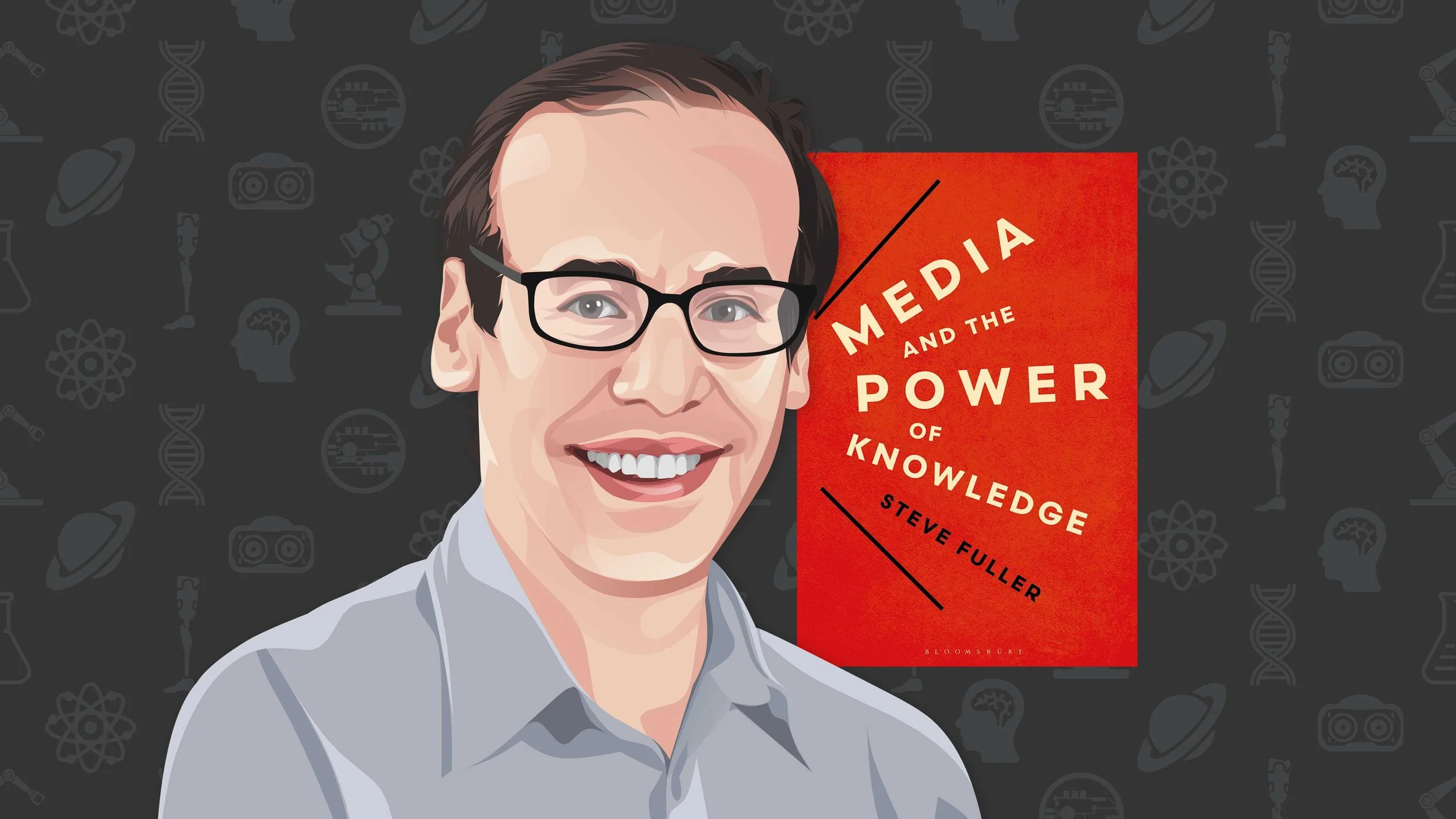
Thinking Through the Machine w/ Prof. Steve Fuller
Episode #85
Listen on Apple Podcasts | Spotify | YouTube | SoundCloud | Goodpods | CastBox | RSS Feed
Recorded live from the University of Warwick on 26 November 2025.
Summary
Sociologist Prof. Steve Fuller shares his insights on how social media and new media technologies shape the way we think, why intellectuals must become performers in the digital age, and how artificial intelligence is unlocking undiscovered knowledge in academic research.
Guest Bio
Prof. Steve Fuller is Professor of Sociology at Warwick University, UK. He has written extensively on politics and social theory and the sociology of science. His many books include Kuhn vs Popper, which was named book of the month (Feb 2005) by Popular Science; The Intellectual was named a book of the year by the New Statesman for 2005; and Dissent over Descent was named book of the week by Times Higher Education in July 2008. He has spoken in 30 countries, often keynoting professional academic conferences, and has been a Fellow of the Royal Society of Arts since 1995. His writings have been translated into over twenty languages.
Featured Book
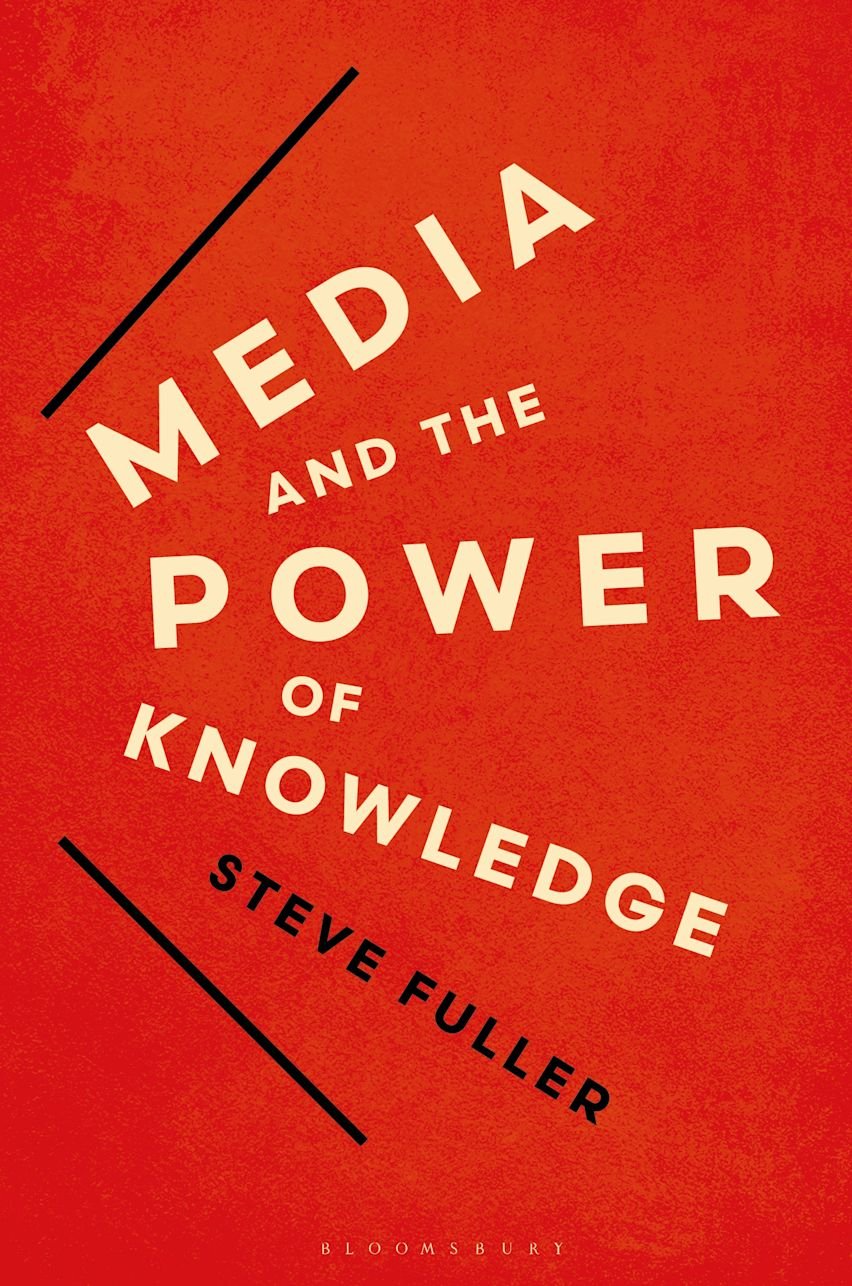
In Media and the Power of Knowledge, Fuller argues that from literacy to digitality, access and control of the available media have arguably done the most to shape the course of knowledge.
Fuller radically extends Marshall McLuhan's slogan, 'The medium is the message', by reading the distinction between 'hot' and 'cool' media through the lens of sociologist Max Weber's 'prophetic' and 'priestly' religious voices, the former demanding that receivers complete the message, the latter that they conform to it.
Readers will find a comparative appraisal of Socrates and Jesus as long-standing media personalities, as well as the fate of individual integrity, expert authority and the public sphere in the radically democratized landscape of the post-truth condition, in which truth-telling has been turned into a performing art that may adopt many forms. Does the tweet signal the return of the aphorism as a conveyor of insight about the world?
Historically and philosophically informed, while presenting provocative arguments that address today's concerns, this book considers the likely future developments of the media and its far-reaching implications for the human condition.
Show Notes
From ancient Greek texts to Twitter aphorisms, media has always shaped what we know, what we believe, and who we trust. In his new book, Media and the Power of Knowledge (Bloomsbury Academic, 2026), Fuller reimagines Marshall McLuhan through sociologist Max Weber’s lens of ‘prophetic’ and ‘priestly’ voices – revealing how every communication revolution, from the spoken word to the algorithmic feed, has determined who gets to ‘complete’ the message and who must conform to it.
Why were Socrates and Jesus the original media personalities? Who are today’s hot prophets and cool priests of new media? And what does it mean to speak truth to power in an age where everyone can broadcast – but few can be heard?
Links
Transcript (AI-Generated)
NOTE: This transcript is AI-generated and unedited. It may contain errors. A human-transcription is coming soon.
Prof. Steve Fuller: If what you wanna do when you're communicating thinking is to induce thinking, then you need short, sharp bites. And so philosophers have been tuned into that from time to time. And I think Twitter in a way provides a kind of ongoing invitation to recover that.
Luke Robert Mason: Your listening to The Futures podcast with me, Luke Robert Mason, live from the University of Warwick. On this show, we meet the scientists, technologists, artists, and philosophers, working to imagine the sorts of developments that might dramatically alter what it means to be human. Some of their predictions will be preferable, others might seem impossible, but none of them are inevitable.
My name is Luke Robert Mason, and I'm your host for this evening
in 2011. I introduced my PhD supervisor, professor Steve Fuller to Twitter. Steve took to this platform with ease, and over the past 14 years it has been the way I access his often uncensored mind. Anyone who follows at Prof, Steve Filler on Twitter. Now X will know how Steve uses a platform as his own personal notebook of ideas, generation, testing concepts in the wild, and experimenting on.
I put on audiences, but also how audiences respond to whatever he's thinking about presently. But being an academics academic, Steve couldn't help but write a book about this lived experience, media and the power of knowledge. The book provides a roadmap for how intellectuals can communicate their ideas in the ever evolving media environment of the 21st century.
This live podcast, what you've joined today is an attempt to put those theories into practice. There is no better space that encourages the performance of ideas than a black box studio. Spaces like this have always been where I do my best thinking in the live, improvisational, interactive, and conversational moments.
So to show us how we can become the prophets of new media platforms, please put your hands together and join me in welcoming Professor Steve Fuller to the Futures podcast stage.
Prof. Steve Fuller: Well, thank you for having me, and thank you for the audience.
Luke Robert Mason: So Steve, I, I'm gonna ask you this question because people may not know, but I was the reason Steve Fuller, uh, ended up on Twitter in 2011, and it's been 14 and a half years and 43,000 tweets later. And I guess my question is. Do you regret that decision?
Prof. Steve Fuller: Well, if I do by now, I'm a glutton for punishment. Um, no, not at all. Uh, in fact, I would say this is something I raise in the book, but I think it's worth thinking about that Twitter is actually very much a, a disciplining medium in terms of the way in which you communicate. Because, you know, the 140 a character tweet used to be 280, but it got cut down.
Um, and um. This is, uh, this seems to me very uncharacteristic of the way in which academics communicate. We usually like to write books and articles with long paragraphs and big words and complex sentence structures, but with something like Twitter, you have to get the point across quickly, especially in a world that has become quite accustomed to short attention spans.
And this is really quite a challenge for academics, uh, because, uh, academics often think that the, uh, the depth of their thinking. Can only be reflected in the complexity of their expression. And, and, and that's not necessarily true. Um, and, and so from a personal experience about self disciplining in the way one communicates Twitter has been marvelous.
Okay. But in a sense, I kind of had a sense of what I was getting myself into. Um, and this has a lot to do with knowing something about the history of media and art and the way in which. The, uh, the medium, right? In a way disciplines the message generally. And that's why Marshall McCluen, for example, plays a very big role in my book.
Luke Robert Mason: I wanna talk to you about that disciplining process. So, so the ability to take an idea and, and reduce it down is, is it's called something, uh, an aphorism, right? And you write in depth about the aphorism in the book and the revival of perhaps the retrieval in a McCluen sense of the atheism through Twitter.
What role does that play in how we shape ideas? And what use does the aphorism have?
Prof. Steve Fuller: Well, I think it's always worth recalling, uh, that the aphorism was sort of the original medium in which philosophy was expressed, uh, both in the Eastern and the Western cultures. And the eastern cultures in a way held onto it longer.
Okay. But nevertheless, there have been periods in the history of the West where, uh, atheistic expression has in fact been, uh, highly valued and, and quite influential and important. Um, and even in our own time, we might think about somebody, well first in the early modern period, some like Pascal. Okay. Uh, blaze Pascal, a very important kind of religious thinker, but he's the one who said the heart has its reasons.
Okay. You, you're probably familiar with that. Um, but then if you go into the more recent past, right, the last a hundred, 150 years or so, we can think about people like Nietzsche and Wittgenstein, uh, who are very influential philosophers, but whose primary mode of expression was in this relatively short kind of form.
And in fact, both of them. Highly valued that short form. So in other words, it was a deliberate mode of expression. And, uh, there's a lot to be said about this, uh, because part of what you want, um, when you're communicating, thinking is that you want to induce thinking in the people you're talking to. And one of the problems with.
The rather long-winded way in which academics operate, um, is that we can bludgeon people with our knowledge, right? So in other words, you, you go through these long paragraphs, you hear these people go on at, at great length, and, and you don't feel like you've been, you know, empowered with thought, right?
You feel you've been sort of verbally beaten, um, you know, uh, into submission. Right? Yes, I believe, I believe. Stop talking and I think if what you wanna do when, uh, you know, you're communicating, thinking is to induce thinking, then you, you need short, sharp. Bites. Right? Um, and that was certainly the case with, uh, Nietzche and Wittgenstein.
That was what they were trying to do. Um, and, and they were quite deliberate about it. But of course, if one thing's about poetry as a kind of model, uh, for communication, right? Where in a very short compass, uh, poetry can express many things at many different levels at once. And the fact that people feel very, uh.
Kind of empowered and even enchanted by poetry, right, is an indication of what that kind of, you, you might say, telegraphic form of communication can do. And so philosophers have been tuned into that from time to time. And I think Twitter, in a way provides a kind of ongoing invitation to recover that.
Luke Robert Mason: So now I'm curious, Steve, how has Twitter disciplined your thinking?
Were there people who were feeling bludgeoned by your ideas before you joined in 2011?
Prof. Steve Fuller: I mean, obviously it hasn't, um. Inhibited my, uh, tendency to write books, right? So, so that hasn't ended, um, right. Um, but I do think, um, in terms of style, one thing I would say, uh, is that, um, I, I have become over the years much more.
Careful about weighing the words. Right. Um, so if you read any of my stuff, I'll just, you know, not to discourage you from reading any of my stuff, but the point is, I think one thing that most people would say about the kind of style of writing I have is it's highly compressed. Right. So in other words, there's, you know, in one paragraph there's a kind, there's enough that maybe three paragraphs would normally express.
And I think in that respect, Twitter actually has had quite a lot of influence, right? Because in a sense you can actually in, in let's say five tweets, you could do like five paragraphs. And, and one of the things that I talk about in the book, in that chapter on aphorism, which is the largest chapter in the book, um.
Early on in, in Twitter, there was this thing, the Twitter University, the Swedish Twitter University. Okay. Um, and so this is around the year 2012. Um, and the Swedish Twitter University invited, uh, academics, t Wittgenstein's, um, to um, actually develop lectures consisting of 25. Consecutive tweets, right? So where the argument for an entire course would be made in 25 tweets, one following another.
And, and this was a very interesting experiment. I think about 15 people, myself included, volunteered to do this and, and I thought that was really quite a great idea. Uh, and at the time, right? The guy who started this thing thought this might take off as a kind of alternative form of education. Um, and I still think it's a good idea actually.
Right to to, to get some kind of, you know, something that might normally take a course or something that might be regarded as very complex. Break it down into 25 consecutive tweets. A bit like a program, right? When you're doing the lines of a program. Uh, and, and so that's an example, right? Uh, that's an example where, you know, this kind of medium can enable quite a lot to be conveyed in a very striking manner over a very short space.
Luke Robert Mason: Well, there's another power to the aphorism that you explore in the book that I wanna unpack a little, which is the ability to place an idea in the world and allow for it to remain open to interpretation That's right. As a way to produce new knowledge or perhaps play with ideas.
Prof. Steve Fuller: Yes, that's right. And, and in a way, this is the, uh, ex, you know, the extent to which aphorism is very much like poetry, right.
Uh, because, um. When you, when you talk about a great poem, especially when you talk about sort of, this is certainly true of modern poems, but not just modern poems. Um, what makes a a great poem isn't the particular meaning that the poem has is if there's this one meaning that the poem has, which once you understand it, makes it great.
No, usually a poem is great because of the way in which the words and the syntax are arranged, right? It is ultimate. OO open to multiple meanings, some of them even mutually exclusive meanings, right? Which in which in each case is illuminating, right? Um, and, and this is something, you know, um, when you, if you're talking about rather long poems, um, you know, sort of allegorical poems such as, uh, Dante's Divine Comedy or Milton's Paradise Lost, right?
Those are those things. You know, because the, these poems are enormous, right? You can get all kinds of interpretations off of these things, and that is the kind of thing that, generally speaking, you want from communication, right? You want people to find multiple enlightening meanings from the experience, not just get a lot of words, and then feel in some sense.
You, you, you're left dumber than you began with.
Luke Robert Mason: In fact, I think it may have been advice that you gave me, Steve, the, the, the best, um, the best lecturers are the ones who allow you to leave the room feeling like you know more than when you came in as opposed to going, I know it sounds obvious, but Yeah.
Yeah. But what the hell was that guy just talking about? And, and in fact, our relationship began when I was an undergraduate here in, uh, 2008 to 2011. And, uh, and you were one of the first academics of the University of Warwick whose books I could actually read. So that was, uh. That was part of the, the era and look
Prof. Steve Fuller: what it's done to him
Luke Robert Mason: and look what it's done to me.
Now. I'm back doing a PhD with, with Steve. So, you know, something went awry there. Um, I wanna double click though a little bit more on this thing around aphorism as a way to generate new ideas because another. Thing that you've been interested in. And and your last book launch that, that we shared the stage together was around post-truth.
Prof. Steve Fuller: Yeah.
Luke Robert Mason: Yeah. And you talk about how aphorisms can create alternative realities, or as you say in the book, uh, alternative ontological interpretations. Yes. So how can an aphorism progress science.
Prof. Steve Fuller: Science is very much motivated by metaphors and analogies. Okay, so you know, when we start talking about light, let's say as waves or particles, right?
Uh, those things begin as metaphors and analogies, and then once one thinks through. What it's like in the concrete setting. And then imagine what it would be like in this other setting. Right? Then you come up with ideas for hypotheses to test, to, you know, experiments, to make things of that kind. And in a way you might think of an aphorism, you know, in science as a bit akin to something like a mathematical equation.
Luke Robert Mason: Hmm,
Prof. Steve Fuller: right. A mathematical equation in a way is a bit like an aphorism. 'cause there, there are lots of ways any given equation can be, uh, interpreted. So for example, um, there's this thing, uh. Called Boils law, which has to do with pressure. And of course this has to do with the, uh, the movement of gas molecules and things like that normally, but it's also a model that's used to try to explain how revolutionary activity happens in politics.
Okay? And it's the same equation, right? Uh, and, and so there are radically different ontologically interpretations, right? Applying to different fields. And nevertheless, in both cases, they're illuminating. And I think this is very much like what the aphorism does.
Luke Robert Mason: So in that case, how can one. Utilize that power.
Leverage that power. How can, as you say in the book, someone write, embracing the idea of actual infinity?
Prof. Steve Fuller: I was reading No,
Luke Robert Mason: your words, Steve,
Prof. Steve Fuller: so I No, no, no, no. I, I understand. I mean, um, see, the idea here is that if you go down one of these paths, as it were, right, so let's, you know, think about, okay, we're going to, uh, we're going to interpret light.
As a wave or we're gonna interpret light as a particle, right? Uh, at one level. Um, that is kind of, um. Bounded, right? Because we're talking about light as a wave or light as a particle, but then all the things you can start to say about light once you start thinking about it as a particle or a wave, is potentially infinite, right?
So the actual infinity, what makes it bounded is the fact that you, you have this starting base of saying, I'm gonna think about light as a particle. But then what you can say in light of that is, is infinite, right? Because there are infinite ways in which one might think about light as a particle. Some of them might be more useful than others, of course.
But the point is, that's what opens up, that's where you get the infinity.
Luke Robert Mason: So how have you personally, I guess, been leveraging that possibility? So 14 and a half years ago, you weren't on Twitter. You've, you've worked out how to use the power of the aphorism to play with ideas. How have you found this has changed the way in which you present knowledge?
You, you say in the book, a intellectual prosody. Prosody, which is a rhythm to thought made because of the constraint of the medium. Have you, have you seen the rhythm of the author change thanks to things like Twitter and has it changed how you presented and, and wrote this book?
Prof. Steve Fuller: See, the whole business about this intellectual prosody is you have to get the rhythm in which people are thinking and the rhythm in which people are thinking have to do with the media through which they are thinking.
Again, you know, this is a very McCluen esque point. Uh, and if people are thinking in terms of these kind of, you know, tweet size thoughts, right? Uh, then your own thinking in a, in a way has to engage with that, right? It has to be, as it were, you can, you, you have to be able to, people have to be able to assimilate you at that level, right?
Um, and so this then, uh, does put a kind of constraint on, on what you're doing and, and, and. How much you can say and how do you say it, and so forth. And if you do wanna say a lot in a little space, you have to be very artful about it. And, and being artful about it may, you know, involve using metaphors or, or turns of phrases in a very clever kind of way where you can pack a lot in, right?
You know, in, in a certain kind of small space. Uh, obviously that requires a certain kind of mastery of language, right? Mm-hmm. Um, and um, so it's a very literary thing at the end of the day.
Luke Robert Mason: Do you think it helps with teaching insofar as, yeah. You were just mentioning there about meeting audiences where they are.
Some of my favorite tweets of yours are where you simply tweet mood and then a link to a music artist. That's right. 'cause I'm, I'm always surprised by who you are listening to. Yeah. But your ability to, I, I'm saying this as if I'm surprised that academics exist outside of the institution, but your your ability to exist within the world.
I mean, this is some of the stuff your undergraduates that you teach are listening to, are consuming. Do you think your ability to use and, and engage with these platforms to be culturally aware of what's hot and what's not? You teach a media course, which was the outline or the underline of this? This book, do you think it enables you to teach better to pack, repackage the knowledge into a way in which undergraduates,
Prof. Steve Fuller: okay, so you're opening up a very big sort of issue about how you generally prepare your mind in the kind of world we live in.
Luke Robert Mason: Okay.
Prof. Steve Fuller: Right, because, um. I think, you know, to, to sort of, uh, step a, take a couple of steps back and to, to answer your question, I think one of the things that would be very apparent to me, uh, but perhaps, you know, you don't have to go through this, I'm not a digital native, right? I was born and lived in a time before we had the internet, right?
Uh, and, uh, and, and the internet came very quickly once it started, right? And all the other things came very quickly too, time-wise. Um. And a lot of, uh, a lot of academics and older people got left behind basically. Um, and, and, and, and, and in a way they're the ones who provide the most negative reaction to what's going on.
And they, and in a sense, they legitimize the negative reaction that oth, you know, other younger people might be feeling. I, I've never felt that way. I think, um. In this respect, I've always been sort of on McClean's wavelength, so my knowledge of McCluen, you know, goes, you know, from my, uh, university, maybe even high school days.
Uh, and um, and, and the idea here is that you do have to surf the media, right? You have to be on top of it. And so, for example, when I'm working. Because most of the time I'm tweeting all these tweets that he talks about, uh, are happening while I'm working. Right. When I'm in front of a, a, a computer typing.
Um, and, and the tweets are effectively, like he said, uh, in the beginning, um, you know, they're like notes. You know, it's almost like froth. It's almost like, you know, the side, the side things you're thinking about while you're doing the thing you're supposed to do. Right? And that's kind of where the tweets are.
So the tweets aren't necessarily about what I'm working on at the moment, but it's about the thoughts that come to my mind while I'm working. And the point about that. Is what keeps all that kind of coherent to me. And this is where the music comes in. I always listen to music while I'm working. And what that does is it creates a kind of zone, right, a kind of media zone, you might say, a kind of, you know, audio visual landscape, uh, in which your thought can be conducted.
And it's one that is quite. Uh, portable as well, right? Because you can be typing and listening to music on a train in your living room, in your office, walking around even potentially. Uh, and, and so you carry that with you. Um. And I always try to make sure, um, that part of the music and it, and it's not so hard, right, is contemporary, right?
It's always kind of contemporary. And so I have a certain kind of vibe in my head about, um, how people are feeling and thinking. That's sort of the background noise. Uh, and that really does help when it then comes down to, let's say, facing a classroom or facing a new audience, especially an audience of young people.
Luke Robert Mason: What I guess I was getting at was, what you talk about in the book is the intellectual as a performer. Sure. So how do intellectuals develop skills to translate across media? And how is this as, as you say, a form of method acting?
Prof. Steve Fuller: I've written a lot about the intellectuals over the years, the nature of the intellectual, and I'm someone who believes, um, that actually, uh, just because you're an academic doesn't mean you're an intellectual.
So I hold this rather, what within the academy is a rather controversial view. 'cause academics usually like to draw a distinction between, uh, intellectuals as a kind of general category, which also includes academics as well as what academics call public intellectuals, right? Right. Public intellectuals is a term invented by academics.
Okay. So they can include themselves as intellectuals as well. Right. Uh, I, I, I actually don't think this distinction holds water. I think it's a, obviously self-serving distinction. I think actually the public intellectuals are the intellectuals and they've always been recognized as such. And when the, and when the term intellectual starts to get currency in the late 19th century, it's the public people who are called the intellectuals, not the academics.
The academics only become intellectuals when they go public. But as long as they stay in the classroom, they're not intellectuals. Right. And that had a lot to do with how one imagines what happens in a classroom. Right. Because if you imagine, you know, your sort of classic classroom experience, it isn't about communicating with students, it's about unloading knowledge on students.
Right. So you're not trying to persuade the students of anything. The students already persuaded 'cause they need to get a mark from you, right? So there's no, there's no persuasion going on here at all. Right? What there is, is the student desperately trying to figure out what do I need to know to get the A?
Okay. Um, and, and, and so that is not an intellectual, an intellectual experience. Right. That is just a desperate grasp for credentials. Okay. And, and, and most of academic communication with students is basically that. Now that doesn't mean academics can't do the intellectual thing, but when they do the, uh, the whole rhetorical setup is radically different.
It's a much more egalitarian one in a certain way. In other words, the, you don't, you don't come in with the audience already agreeing, with you already being forced to agree with you, right? Because you hold so much power over them. The intellectual, in a way, is. Quite accountable to their audience, right?
And as, and if you know anything about the history of intellectuals, you will know that they very, they tend to get into trouble, right? Because they aggravate people. They aggravate people, not because people don't understand them, right? Or feel too stupid around them, but because they understand them all too well, right?
Now, that is a success of communication, right? When you can insult people and people recognize they're being insulted. You're making progress here. Academics insult people all the time, but the people being insulted don't understand what they're saying. Right. It's a big difference, right? It's a big difference.
Luke Robert Mason: Oh, I've just realized something.
Prof. Steve Fuller: But,
Luke Robert Mason: but, but, but in these platforms, let's take one step back and, and all alright,
Prof. Steve Fuller: I didn't fully answer your question yet, but I was just getting going
Luke Robert Mason: again. But I wanna take one quick step back about where these intellectuals, these public intellectuals, whatever you wanna call 'em, where they operate.
Because in these platforms, it's not just, you know, Twitter's not this, uh, egalitarian, intellectual space. It is a place for the sage, but it's also a place for the propagandists, the advertisers, the Conspiracists, the fantasists, they all exist together on the same platform. Platform. Mm-hmm. Yeah. So how do we navigate if, if that is the environment in which now they find themselves,
Prof. Steve Fuller: look, I am inclined.
To treat all of these characters you've just mentioned as pretty much, um, in the same basket. Um, right. And, and that, you know, the person we call a sage versus the person we call a propagandist. Right. Uh, a fantasist even, right. Or an intellectual. A lot depends on the framing of what the person is saying.
Rather than what anything you can say very specific about the person themselves, but a lot about the framing. Um, and I think one of the things that you, you know, that we have seen in our time with social media, in fact, I, I brought this up in one of my seminars today. Uh, there is this thing called the Overton Window.
Maybe some people are familiar with this, the Overton window. Uh, you, you know about this, right? And the idea here, and, and this is an idea that that in a way has gotten a lot of currency because of social media. And it's about framing about what is considered acceptable and not acceptable to say. And one talks about the opening and the closing and the shift.
Of the Overton window in that regard. Right? So certain things that you people would never consider possible now are considered very possible and vice versa, right? And then different groups have different Overton windows, as it were. Okay? And one of the big problems with the post-truth condition is that the Overton don't.
Match up, right? Everybody's is different and it's constantly moving around. And so one person's sage is another person's fantasist, right? So that's what it boils down to. And so the intellectual space is very fluid in that way. And, and so intellectual then just becomes a very general word for the people who are in fact trying to address the audience, you know, about, about, you know.
Ideational things about what they should believe, what they should think, who you know, and, and that sort of thing. But who, you know, who gets taken seriously and not seriously is really a quite an open question.
Luke Robert Mason: Do, do you think that has, in part, to do with audience capture, so if the audience is, if attention is the economy or the online environment, do you think that some intellectuals.
Gravitate to what they know will get an audience response. In fact, you, you say in the book that you often find that public intellectuals gravitate towards the most controversial topics did.
Prof. Steve Fuller: Yeah, but that's a different issue, right? I mean, they do that as a matter of principle in a sense. We're talking about two things at once.
Okay. Right. Uh, I mean, because intellectuals tend to get into trouble because they're not predictable. Right. They, they, they tend to be mercurial sorts of people. I think what we're talking about in social media is a kind of transformation process, which may begin, you know, so I think Right, right. I think this is true, but this is probably true of you too.
Um, you know, I, I mean, I be careful what
Luke Robert Mason: you say. I, I, I have control of the edit.
Prof. Steve Fuller: Yeah, yeah. No, I, I understand. No, but the point is that I think, um, when people want to address a large audience on intellectual matters through social media, let's say through a podcast, right? In, in the first case, I, I don't think most of these people do market research.
I think what they do, right? I mean, they, what they do is they go out there and do their thing in a sense, right? And as the audiences respond, in a sense, their thing gets refined. Right, and then you grow the audience, and then you can expand outward, and then after a while, right, this then becomes your signature thing, right?
You've got this kind of cash and, uh, you know, of of, of people who will always be listening to you and, and in fact, you can kind of parlay that for other forms of capital, of course. Right? If you could say, I have 3000, 300,000 people that are listening to me. You know, say my thing. Right? Um, in a sense that can be used to leverage to get other things right, of, you know, sponsorship, whatever.
Um, and so that's a different kind of game, right? It's, it's certainly an intellectual game, but it's one that's very much molded by the distinctiveness of social media, right? So in a sense, that's where social media in a way, uh, is doing, uh, something to the intellectual when, when we talk about technology.
Uh, developing, uh, determining the way people think. We sometimes use the word determining too strongly, right? Um, social media actually is a, is a relatively freeform technology. Um, and it's not, you know, yes you can get 300,000 people who are wanting to, to listen to you, but you know, at the end of the day, um, you like that, right?
You want that, right? In a sense, that becomes part of who you are. So it's a kind of mutually determining thing. It isn't, you know, it isn't just, you know, Jordan Peterson being captured, my God, how did those millions of people capture his this great mind? No, he's complicit in it very clearly. Right. And, and you know, there are people, and this is where we get back to the classic intellectual.
There will be a certain kind of person who at some point will disown their followers. And, and will in a sense say, look, I'm gonna shed a hundred thousand people. I don't care. 'cause this is what my view really is. And that is more like the classical intellectual, right? So the classical intellectual, very, you know, typically gets a platform.
A lot of people think this person's courageous or smart or whatever, and they follow him. But then one day this guy decides on another issue. To say something completely crazy. Right? And then everybody goes nuts, you know, and, and, and you know, sometimes these people get killed and, you know, all that kind of stuff happens.
Right? Um, and, and so, you know, this is the thing that you would want to be looking for in the podcasters to kind of mirror the experience of the classical intellectual, the podcaster, who at some point after they get there, you know, couple of hundred thousand, 2 million followers suddenly say, look. I've been talking about this stuff for a long time and I'm listening to the sound of my voice and I don't like what I hear, and so now I am going to change my tune.
Right? That is kind of more like, and that's what gives the intellectual and inte integrity, right? Because it looks like this person is not being driven by the fans, but rather as someone who's autonomous. Right. Someone who directs themselves. And so when they hear their own voice and they don't like what they hear, they have the power to change themselves.
Luke Robert Mason: Well, you mentioned the podcast
Prof. Steve Fuller: is remember Christopher Hitchens? Yeah. Okay. Christopher Hitchens is a great example of what I'm talking about. This is a guy, right, who went from the the left, very left right? And over the course of events, right in the 1980s and nineties into the two thousands, you know, gradually sort of came in line with the neoconservatives.
It's kind of interesting thing, and it wasn't an overnight thing either. It was just that as he was thinking and talking about the events of the world as they were unfolding, it changed his mind. And that's a real intellectual,
Luke Robert Mason: the ability to change one's mind.
Prof. Steve Fuller: Yes. And do it publicly. Do it publicly. Do it in real time.
Right. And the thing is, social media in a way is very challenging for this, right? Because social media has everything in real time. Everything is public. And, and in a sense, you know, if you're Jordan Peterson, you have to have three pod three podcasts out there a day to keep the, you know, keep the fans happy, right?
And, and so you don't actually have a lot of time. In a way to recoup right to, you know, uh, and if all of a sudden you, you know, your next podcast says up, I'm doing a 180 on this, right? Um, people will just go nuts and think you're crazy.
Luke Robert Mason: You gotta redo the, redo the, uh, redo the podcast tour. But you mentioned podcasting there.
And then the reason, not just because I have a podcast, but the reason I'm interested in podcasting is because to some degree that does define what ideas get. Platformed what ideas get attention? You look at the, the major podcasters, the, the Joe Rogans, the Chris Williamson, the Stephen Bartletts, you know, they become the, the arbiters of whose ideas we get to hear and in what format we get to hear them.
Do you think this is anything new or is this just a different iteration of what has come before?
Prof. Steve Fuller: Well, I think ultimately it's not, that's not one of the newer things. Okay. So I would say if you look at newspapers right, in terms of, uh. Especially in the period when, when, uh, newspapers were controlled by great media moguls.
Right. In a sense, those guys right, actually, uh, had control over who would actually be writing, you know, the opinion pages on their, you know, in, in the newspaper, right? And very often they had to fit certain kinds of ideological lines. Certainly this is true in this country. Um, and, uh, what that meant was that certain kinds of voices just never had a platform, if anything.
We are living in a period where it has become easier for marginalized voices to get platforms. Right. I mean, um, and yes, one of the consequences is that, that the platforms that exist now, some of them can become huge and enormous, but you know, in a sense, um, you know, somebody like Joe Rogan, you know, who is a big deal, right?
In, in, in the platform world, I don't know if he's a much bigger deal than, let's say the New York Times was in its heyday or the times of London, right? If you, if you look at the 20th century or 19th century, right? I mean, I don't know if Joe Rogan is bigger than what they, those. Institutions were back then in terms of being able to foreground, uh, certain kinds of ideas and not, um, so I don't think that aspect, even though the medium's changed, I don't think that aspect has changed so much.
Luke Robert Mason: Well, it's, it's quite clear in the book that some things just haven't changed. I mean, you go as far back as Socrates and Jesus, how have these voices been, uh, recognized and then recognized through different forms of mass communication?
Prof. Steve Fuller: Well, I think one of the, one of the things that, that you might say.
Has helped, uh, Socrates and Jesus's media phenomena is the fact that they didn't write anything. Um, in other words, everybody else is writing about them. Uh, and, and, and in fact, both of them had extremely good publicists, uh, in particular, um, Saint Paul for Jesus and Plato for Socrates. Um, and, and in, and of course, both of these guys, St.
Paul and and Plato were writing after, uh. Jesus and Socrates died. Uh, so there wasn't, uh, you know, anything that, that could be complained about. Um, and of course they weren't the only ones who wrote about these guys, right? All kinds of people did. Um, and, and, um, one of the things that I point out in this chapter, so I have a chapter on, on, uh, basically Socrates in Jesus as a media.
Personalities, um, is that they were celebrities, uh, in the literal sense of the word from Latin, which has to do with frequency. Some things is, you know, so in other words, people are always talking about them. Some of you know they're very polarizing figures, right? A lot of, you know, there are people who like Socrates and don't like Socrates are people who like Jesus and don't like Jesus.
But the point is. Everybody's got an opinion about them. Okay. And, and that's, that enables then the media cycle to go, uh, and it's one that gets maintained, uh, you know, over, you know, many centuries. Right. And it's quite an astonishing thing. Um, and, and in a sense, the historical aspect of these guys, um, doesn't matter so much, right?
Because they become kind of free floating media personalities. Right. You know, uh, and, and, and so they're adaptable to all kinds of media, right? So you can paint the paint about them. You can write about them, right? You could do anything about them, right? In a sense, they, they, they, you know, and we might say this is because their spirit lives on.
Well, maybe that's what it is. But, but it does have a kind of media, an a media implication that makes them, in fact, very powerful as media figures.
Luke Robert Mason: You mentioned, though the word powerful. I mean, that, that is the, the, the impetus of the book, the relationship between media and power, and how do we use Marshall McClue and, and Max Weber, who you introduced to understand that relationship.
Prof. Steve Fuller: If any of you have ever read Marshall McClue and you know, the man is very slippery character in terms of what exactly he means by what he says. He, he's, he's, he's actually very good in this kind of atheistic style of expression, right? He has all these. All these expressions that you are all familiar with, like the medium is the message, right?
And, and, uh, but what the hell does it mean? Um, and, and, and this is a very, very characteristically alistic where you can have it mean one thing and then have it meaning the opposite thing. And you can see scholars kind of interpreting this in all kinds of ways for their own purposes. Well, so I do, I do this too?
Uh, and, and what I'm doing, uh, is to take the distinction between hot media and Cool, cool, cool media. Hot media, cool media, right? Which is a very famous distinction that, uh, McCluen, um, introduces and, uh. I mean, the examples that he gives are fairly straightforward. It's just what he's trying to get across in the distinction.
Um, you know, so Hot Medium would be a, a, a book, uh, at least in the beginning. Uh, you know, when, when, when. And uh, also would be something like radio. Um, and the idea being. That the, uh, communication is happening very intensely, uh, at one or relatively few dimensions. So, in other words, um, you know, you're being approached in a very specific kind of way, right?
So with radio, you're listening, right? You're not wa you're not seeing anything. You're listening. And so as a result, you have to create images in your mind about what's going on. So, right, it's hot in that sense. Right. And with a book, right, you read the book and to understand it, you have to imagine things.
You have to, you know, and sometimes the book tells you things that kind of propels you to do things. You might be crying as a result of reading the book. You might get angry. Right? Right. Um, and, and so the, the, it really, that's what makes it hot, right? The media's hot, but there are other kind of media and television would be the example that McCluen always leans back on.
Right. Um, which are cool, um, right in the sense that you insert yourself into it. The, the media surrounds you, right? Uh, and you just have to be there and soak it up, right? You don't have to do much. You just, you know, you can hear it and watch it, you know, and just stay there. And, you know, back in my day we talked about the couch potatoes, right?
These people who would just spend all their time watching television, and that's cool. Right. In the sense that you are cool, you're just chilled, you're just there, right? Uh, absorbing yourself. And this is kind of the spirit of the, uh, distinction between hot and cool. And, um, what, what I do with that distinction, which I think is a pretty valid distinction.
Um, and I, I do a couple of things. One thing I do is to say, this is not, uh, you might say, this is not just an absolute distinction, hot and cool, right? Because the thing is, once people, once new media. Because, so new media in a way begin hot, right? Because they become something you have to engage directly.
It's not like the way you normally do things, right? So if you're gonna get something out of it, you gotta do something new. But then after a while you get used to the media. Right. And the, and the media, you know, so for example, even with the history of books, right in the beginning, right? The book that was published was the Bible, which is a very, uh, challenging book, right?
Even if you can read, um, and, and you know, but after a while books get written that of course are kind of closer to the experience of the people who read them. Right. And in fact, this is why the people buy them. Uh, and, and so in that sense, then you can read for entertainment, right? You can, you know, you can read, uh, for, you know, you can read, so you can disappear, right?
Uh, in other words, reading is no longer a challenge. The same thing with radio. Okay? Right. You think about the different kinds of music, right? Originally it was classical music that was on the radio, right? And that's very challenging, right? But then after a while you get popular music, you got muac, right?
You get all kinds of stuff that, you know, background music, that's a cool medium, right? RA radio turns cool then, um, and then it can heat up again perhaps, right? So, so the point is these are not, these are distinctions that can move around. So that's one thing that I do, and I think this is very important with regard to, uh, the introduction of the computer medium, which is kind of what this chapter aims at getting us to, you know, what kind of a medium is the digital medium, right?
In terms of this McCluen stuff. Um, because it's quite clear that the digital medium began as a hot. Okay. Um, and, and you know, the re internet was very revolutionary. Um, you know, it empowered new people. Uh, it required new skills in a sense, right? But as soon as we started to move into things like, um, smartphones, right?
User-friendly devices, which require in a way very little knowledge of the technology itself, right? Because everything has been made, uh, user friendly, right? You have interfaces that in a way are designed. To make it as easy as possible to access what you want to access. So the technology becomes invisible, then it becomes a cool medium, right?
And, and, and, and it can be, you know, it could not only be cool, you might say it might even become cold if you become dependent on it, right? Uh, and, and that you can't get yourself out of it. So the distinction between you and the medium. Completely disappears. Um, and, and so we might, you know, we might be in that state.
Um, and so that's kind of, uh, so that's how I, I I plot the McCluen thing on the digital medium now for Max Weber. Okay. 'cause this is where, this is very important too. Max Weber is one of the classical sociologists, right? One of the founders of the discipline. And he was, and, and he wrote about many things and he wrote about the sociology of religion and, and uh, and he makes a very interesting distinction between two kinds of roles that exist in religions.
One of them is the prophet, okay. And the other is the priest. And these are very radically different figures and very often kind of opposed to each other, even if we're talking about the same religion. Now, the prophet is the hot medium, okay? The prophet is the one who is telling you things that you may not have ever heard before or don't even want to hear, right?
The prophet is the one who goes out there. But the, but the message is not complete by the prophet, right? The prophet just throws it out there for you and you have to somehow engage with it, right? It's up to you where you take it, and it's not at all obvious where you go with it, right? So the prophets are the people who found the religion.
Right. The founders of the religion tend to be the prophets, and then the priests are the people who take the religion in various directions. Afterwards, they institutionalize the religion and usually this is after the prophet is dead. It's always very convenient for your prophets to be dead. Sometimes you might even need to kill them in order to have institutionalized religion.
Um, and so the thing is that the priests are the people who come up with a kind of normalized way. Of actually responding to the message, right? And this is where it become, where the message cools down because they, they become established ways of following, let's say, in Jesus' footsteps, right? So it's not just you interpreting Jesus how you feel, right?
Uh, it's rather you have to go to church, you have to do this and that, and the other thing. You have to engage in these rituals, right? And all of that then get, becomes integrated into your life, right? And so you cannot understand. The words of the prophet without doing this normal stuff. Right. And, and that is the priest.
And, um, with every change in technology, right, the originators of the technology tend to be very prophetic figures, but then there are the priests who kind of normalize the usage of it. And this is the kind of thing, uh, that I'm talking about, uh, generally speaking in that chapter.
Luke Robert Mason: Do you think the, the new, I guess not even.
Person, but perhaps entity that is normalizing knowledge is the digital medium itself. Ai, uh, because we're seeing more and more, these platforms are less and less, uh, populated by human beings and the propagandists, the advertisers, the conspiracists and the fantasies that we, the fantasists, sorry, that we see are AI chatbots.
They ape. The language that has come before. Do you think they're useful for generating new forms of knowledge or is are they the new. Profits, I guess, of, uh, of what knowledge has been placed into these platforms previously?
Prof. Steve Fuller: Let's put it this way. One, one of the things that is very, uh, was already, uh, uh, there when, when computers started to mediate everything that's happening in the world, right?
Uh, as soon as computers became kind of the infrastructure of, you know, everything was that, um, our lives were becoming more integrated with our technology in all kinds of ways, uh, and. And that's pretty obvious now, now with artificial intelligence that takes it to a next, to the next level because it, it obviously means a certain kind of integration with our minds.
Uh, and um, when we talk about something like generative artificial intelligence and all of the hopes and fears that people attach to it, um, I think the first thing that is worth. Pointing out is that the, the technology is impressive, but of course what the data is that the, these technology are feeding on and from which they produce results that we're impressed with is our own stuff.
Mm-hmm. Right. Um, and, and this is where it gets kind of interesting because this is not really a case of some foreign entity called artificial intelligence potentially eating our minds. No. We've already fed them. We're fed them, our minds right? We're in the process of feeding our minds of their minds with us.
Okay? And then, you know, we are getting results and often the results can be quite surprising. Why? Well. In a, you might say, well that's because this AI stuff works really well. Well, yeah, obviously there's an obvious point to that. Um, but also because we, ourselves as human beings who have produced the stuff that we put into the ai, we ourselves have never read it properly.
We have never understood it properly. We have never processed it properly. We have just produced it. And in a sense, what AI is doing is it is challenging us in a way, right? By, in a sense that because the AI can do a lot of that kind of processing much more effectively at a much larger scale than the ordinary human being does.
But what it does is it reminds us of all the stuff that we ourselves have produced having to do with knowledge that goes systematically, uh, underutilized. And maybe even unread altogether. And so that makes it a very interesting, very exciting kind of situation.
Luke Robert Mason: Do you then think that AI can perhaps u utilize the aphorism to produce advance and create new forms of knowledge?
Prof. Steve Fuller: Well, you know, one thing that's very interesting about, you know, if you use like chat GPT and everything is that you can customize it indefinitely, right? Right. So in other words, you can tell it. How long should the response be? Right? So you could, you, you could in principle, I would suppose, um, you know, say I am trying, I am trying to come up with a way of encapsulating this very complicated thought.
And you write a 200 words, let's say, um, and I'd like you to do that in an aphorism, right? That is no more than 280 characters or something like that, right? Uh, it could probably do that.
Luke Robert Mason: But, but what I'm getting at Steve is, is Ken. These tools, can they reveal to us the problems that we should be working on?
Can they
Prof. Steve Fuller: Yes.
Luke Robert Mason: Yes. They can do look at knowledge and, and, and give us back a, a, a one of those possibility spaces, one of those infinites. Can, can we read something that AI has produced and understand?
Prof. Steve Fuller: Yes. This is, uh, this is something I have written about a lot and, and it's this concept of undiscovered public knowledge.
Um, and this is, and, and again, if you think about what. What generative AI is being fed. It is largely the academic publications. And if you look at the academic publications, you know, you look at it from a, a kind of bibliometric standpoint, you know, that is to say, you know, you look at, um, who, who's reading what, who is citing whom, right?
You look at all that phenomena, you find that basically 80% of all the stuff that's being published goes pretty much un unsighted or unread, uh, and in fact, very much the whole. The whole ethos of academia is to always be at the research frontier, work on the stuff that all the smart people are working on, right?
Uh, don't, don't work on this. You know? And there are all these areas that are kind of marginal and you shouldn't be working on those, right? Nobody will read your stuff. You'll never get a job, you'll never get promoted, you'll never get funding, right? Uh, but, but nevertheless, that is most of the material that's actually produced.
Now, you see AI doesn't come in with those biases. AI does not have the bias right. Of thinking, you know, so if you ask AI a question, a straight question about something, right? It in principle should be able to search the whole knowledge space, uh, that academics have produced without prejudice and say the kinds of different possibilities and answers that are out there to address it, even if nobody has explored them before.
Right, and that is a great Ben, a potential benefit of AI to help human beings utilize more of the knowledge that they themselves produce.
Luke Robert Mason: How do you hope intellectuals and academics will embody the concepts that you present in this book?
Prof. Steve Fuller: My own personal view is you need to be, uh, adept in multiple media, right?
Uh, so in other words, uh, you have to be, you know, you have to recognize that if you want to get knowledge, ideas, whatever it is across, um, there's not just one way to go. And certainly the, uh, the, the classical academic way to go is in fact becoming less and less effective in a market that has enormous numbers of competitors.
And so you have to be. You know, capable of doing podcasts, you have to be capable of doing the 32nd soundbite. You have to be capable of doing the tweet, right? You have to be capable of doing the TikTok video, right? You have to be that kind of a person who in a way can translate their ideas, uh, with relative ease into the different media, right?
That it seems to me that any. You know, intellectual of the future, uh, would have to be of that character.
Luke Robert Mason: Well, on that wonderful note, I hope that our audience embraces new ways of translating their ideas into these 21st century mediums. And I wanna thank you for joining us for The Future's Podcast live.
Steve's book, media and the Power of Knowledge is available from Bloomsbury Academic. If you like what you've heard, then you can download The Future's Podcast on your favorite. Podcasting app or follow us on social media at Futures podcast, more episodes, live events, transcripts, and show notes can be found@futurespodcast.net.
Please put your hands together and join me in thanking professor Steve Fuller. Thank you. Thank you everybody.
Credits
If you enjoyed listening to this episode of the FUTURES Podcast you can help support the show by doing the following:
Subscribe on Apple Podcasts | Spotify | Google Podcasts | YouTube | SoundCloud | Goodpods | CastBox | RSS Feed
Write us a review on Apple Podcasts or Spotify
Subscribe to our mailing list through Substack
Producer & Host: Luke Robert Mason
Assistant Audio Editor: Ramzan Bashir
Join the conversation on Facebook, Instagram, and Twitter at @FUTURESPodcast
Follow Luke Robert Mason on Twitter at @LukeRobertMason
Subscribe & Support the Podcast at http://futurespodcast.net