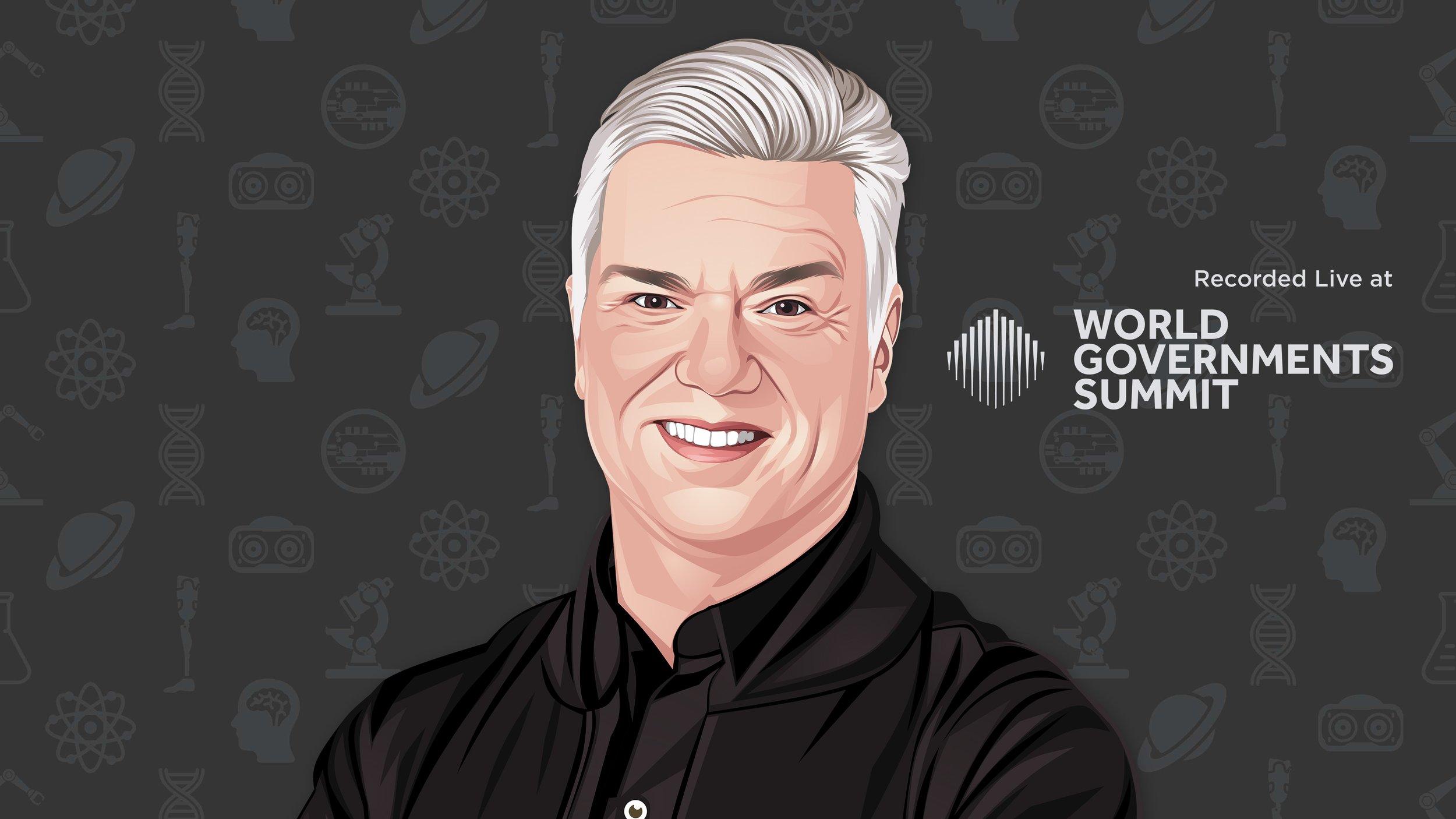
Esports is Changing the World w/ Paul J. Foster
BONUS | World Governments Summit #02
Listen on Apple Podcasts | Spotify | YouTube | SoundCloud | Goodpods | CastBox | RSS Feed
Bonus episode recorded live from the World Governments Summit at the House of Impact on 05 February 2026.
Summary
Global Esports Federation CEO Paul J. Foster shares his insights on the role games could play in shaping the future of society, how artificial intelligence may transform the gaming ecosystem, and why esports could emerge as a strategic platform for economic development and diplomacy.
Guest Bio
Paul J. Foster is President and CEO of the Global Esports Federation (GEF), where he has been instrumental in shaping the organisation’s vision and expanding its global presence. Under his leadership, the GEF has focused on promoting esports as a platform for social impact, inclusion, and innovation.
Foster’s extensive experience spans over two decades in the Olympic movement, including roles at the International Olympic Committee (IOC), where he led teams at more than 12 Olympic Games and served as Head of Protocol, Events, and Hospitality. His background also includes leadership positions in major international events such as Expo 2020 Dubai and Expo 2025 Baku, Azerbaijan.
Show Notes
Coming Soon
Links
Transcript (AI-Generated)
NOTE: This transcript is AI-generated and unedited. It may contain errors. A human-transcription is coming soon.
Paul J Foster: We are living in the age of gaming, and this will only accelerate to the point of. The entire world participating and if you connect the world and connect people, you have a very high chance of making the world a better and a more happy place.
Luke Robert Mason: You are listening to The Futures Podcast Live from the World Governments Summit. On this show, we meet the scientists, technologists, artists, and philosophers, working to imagine the sorts of developments that might dramatically alter what it means to be human. Some of their predictions will be preferable, others might seem impossible, but none of them are inevitable.
My name is Luke Robert Mason, and I'm your host. Gaming and eSports are often framed as entertainment, as spaces for fun, play and escapism. But they're rapidly becoming something far more consequential For my guest today, president and CEO of the Global eSports Federation, Paul J. Foster Gaming and eSports are national capability platforms.
As a leading voice on how gaming is reshaping culture, Paul sees games as an engine to activate youth, to accelerate digital skills and to attract foreign investments. For him, the sustainable future of gaming depends on thinking beyond competition or merely content, and instead recognizes eSports as a platform for building infrastructures for economic development, social inclusion, and even diplomacy.
So Paul, welcome to the Futures podcast. Thank you very much, Luke. The first question I have is, what are some of the unrealized capabilities and perhaps opportunities of gaming and your field? eSports?
Paul J Foster: eSports as we define it. The, the, the famous four words organized competitive video games, um, is really talking about the future of entertainment as we see it through the lens of gaming.
Now, as we are living in the fourth industrial revolution, it shouldn't surprise us that we're now playing games in the in, in a computer form and in an electronic form. One of the great things about gaming is that. It's, uh, very, very human. You know, as, as humans, we love to play games. We like to play all sorts of games.
In fact, even meeting you today, Luke, the first dialogue was really a little bit of gameplay. Who are you? Who am I? And often we take that on through storytelling, telling you, I bet we have a connection in common. And we were able to unpack that pretty quick. And so in the fourth industrial revolution, it doesn't surprise me that much of the world, 4 billion people.
Are playing games.
Luke Robert Mason: So if that's the case, if there's 4 billion people playing games and, and we're all playing games in everyday life, what is under misunderstood or I guess underestimated about gaming's impact?
Paul J Foster: Well, I think that what's fascinating about gaming and eSports is that it's actually very well understood by Gen Z and Gen Alpha and perhaps, um.
A bit slightly less understood by older generations. Um, so one of the things we like to do at Globally Sports is really talk to the young people, our community, the 4 billion people around the world that play games as every part of their life. But what we also understand, um, through industry and here at the world, uh, government summit in Dubai, is really the economic benefits that that has.
That's something I think we'd like to talk about and. I think governments are really, um. Uh, starting to really understand the economic benefits and as you said in your introduction, the enabling benefits to youth engagement and across the whole systems. And I'll give you an example. I think that we should be looking more towards gaming and eSports, just like we look at, um, policy around aviation and energy.
Now, one would never approach those very complex industries, um, with a. Sort of knee jerk reaction, right? There'd be a longer term play. And what we're starting to see, particularly here in the UAE, but in many countries around the world, is developing these strategic framework, um, vision and mission and strategies to unlock the enormous potential across gaming and eSports.
Luke Robert Mason: Well, you've mentioned there, there's enormous potential, there's enormous economic benefits, but you frame that as, as. eSports and gaming being able to become these national capability platforms. So what do you mean by that term?
Paul J Foster: So I think that if, um, if we look at the way that countries and nations connect with their younger populations and think about, let's use an example, the future of work.
Mm-hmm. How will we working? A very few years ago, we didn't understand something called the creator economy. Mm-hmm. And now many, many people, when we think about jobs, when I started my work in the hotel business, for example, back in the late eighties, early nineties, um, I assumed that that would be my career for life.
Um. What we now understand that most careers are about a year and a half or two years. So in a young person's age 20, they're going to have multiple different career channels and different lenses that they're gonna look at their career. And a lot of that are gonna be around the creator economy, whether it's in media.
Game development, whether it's in, um, event production, for example, and all of the adjacent industries. And that's why it's so fascinating because gaming and, uh, eSports as the competitive lens around gaming really has the ability to unlock a lot of those, um, opportunities. Now, in a panel yesterday when we talked about as an enabler, for example, what can governments do to really.
Accelerate those opportunities for their communities. Now, this is real business gaming and eSports is $650 billion projected by 2030, and we see that moving and it's not something that's ever slowed. The rate of growth might have. Slowed a little bit. I would say it's matured a little bit. Um, but now we're seeing consistent growth year on year in double digits.
Um, heading towards that 2030 number of, around about 600 plus billion dollars as an industry.
Luke Robert Mason: Wow. I I hadn't realized the scale of the, the opportunity there. And, and I guess that that comes across in the language and the way you've talked about gaming while you've been here at the World Government Summit, because you've talked about how gaming can lead to new diplomatic.
Infrastructures and opportunities.
Paul J Foster: I love our motto, Luke, our motto, we put two words together and we fused it as one. And our motto is World connected.
Luke Robert Mason: Right?
Paul J Foster: And let's think about that for a moment. So here we are at the World Government Summit in Dubai, where really the Dubai government and the leadership has really brought the whole world together.
Two weeks ago we were in Davos at the World Economic Forum. And here one of the things we understand is humans, we love to connect. There's nothing like being in real life. Um. And there's nothing like being connected. And one of the things we've had a great opportunity to do here in Dubai is have a chance to talk to governments from all over the world.
Very large countries, very small countries, emerging countries, highly developed economies, and everything in between about developing strategy. Because here's the message, there is something for everybody in this ecosystem, and I believe that if a government. Doesn't have a strategy in and around gaming that they're really gonna miss out on the huge economic benefits that will come for their communities.
And also, I would suggest the lack of connection particularly to the younger, uh, demographic inside the nation. So I think the message is that there's something for everyone and it's really an opportunity for them to show up and create a strategy that resembles best those individual national priorities.
And that's exciting. And I'll give you an example, something we focus on. Very well, very much at the global eSports Federation. It's far more than just building arenas or even game studios. You know, it goes much deeper. And three areas of particular focus to us is in and around education, in and around healthcare and wellness, and in and around financial technologies.
Those are the three areas that this year, in 2026 we're gonna really double down on. Um, thinking about getting, helping governments to get their workforce ready in a way that will make sense for the future. Keeping that workforce healthy and focused on their individual and community wellness, and then having the financial rails to bring that to life economically, which is critically important, both at the national level and the community level.
Luke Robert Mason: It feels like there's a cultural piece there as well. So what gaming's able to do is it's to bring different cultures together across national boundaries and celebrate those different. Cultural differences within the, the different environments they game.
Paul J Foster: Yeah, I love that point. You picked up on the celebration and I think, you know, part of being human I think is also something we miss, but it's, it's key in the word, right?
Games it should be joyful Right. Now, let me give you an example. So in gaming, it's, you should really, we should really consider it almost as a language, right? A language, uh, a universal language, sometimes. People might observe gamers as people that are isolated, but those people are actually building communities of hundreds and hundreds and hundreds of people in their community gameplay.
And another quick example, um, during the pandemic period, which obviously is when for us at least, gaming truly exploded and eSports truly exploded while traditional sport really paused, paused, and almost stopped. If you think about the Tokyo Olympics, never in the history of the world, even through World Wars, had the Olympic Games stopped and they had to retime the Tokyo Olympic Games amazing.
And during that period, gaming took off and then all the traditional sports reached out and said, how can you help us think about virtual sports and the future of sport through the gaming lens? How incredible. Educators reached out and said, we need to think about this. How do we, healthcare reached out and said, we need to think about this financial services reached out and how we can help us gamify our industry.
But a personal story I'd like to share is that during the pandemic when. All of us were isolated and many of our younger, uh, populations were really concerned about their mental health and their community health. Because to be isolated for a, not only a long period of time, but a time that had no clarity on when it would resume, um, was something that really concerned me in particular.
There are many, many, many stories, and I believe gaming in so many ways, and people have written about this, saved lives and communities during that pandemic by creating this point of connection. And I can give you many examples where people learned new languages. They made many more friends than they ever had before.
So it's a misnomer to think of gaming as isolated. It's just a different way that. Particularly younger generations connect, but not only younger generations, everyone has the ability to connect through the platform of gaming.
Luke Robert Mason: You mentioned that there's multiple stories. Is there a specific story that speaks to you?
Was there a specific moment that you realized, wow, gaming is this thing we can really use for good.
Paul J Foster: Yeah, I thank you for the chance to talk about that. There's a specific moment that I found fascinating. There's a gentleman in Santiago, Chile, a young guy who had been studying engineering for many years and hadn't found his, uh, hadn't found the right, you know, his place.
You know, he was not particularly satisfied, of course, generations. His father, his grandfather were engineers and he was destined to sort of go into eng in, into engineering, and, um. During the, the pandemic, again, uh, isolated in Santiago, Chile, uh, speaking Spanish, um, and was able to learn a new language, was able to learn English.
That same gentleman now went to one of the best gaming academies in the world Wow. In Orlando, Florida, and was able to gain the skills and became valedictorian of his. Of his school and now has an incredible career at the very pinnacle of game design. And his mother called me, perhaps the most important call I had that year, and she said, Paul, I wanna say thank you to you because you gave us back our son.
Luke Robert Mason: Yeah.
Paul J Foster: Not only have you given him a new industry, a new business, a new series of friends, hundreds of friends, you've given him language skills, business skills. You've made our son joyful and you've given him a career. And in fact, now he's a much happier human being because he's been able to realize his journey.
Through the lens that he sees it. How cool is that? And there's hundreds and thousands of stories like that about women and people with disabilities and older people and younger people and populations that were always often marginalized or living in the shadows, who have been able to not only come into the center, but to find a place that they can call home.
It's very, very powerful.
Luke Robert Mason: So what is it then? What? What is it about gaming? What is it about play that helps us relate to these big abstract problems like. Climate change, inequality, mental health, what is that special source?
Paul J Foster: The first thing I would say is that in gaming, um, there's really something for everyone.
You can find your place. You can find your game, whether it's chess, whether it's sim racing, whether it's, uh, a great game I enjoy by epic games called Rocket League, or you know, tons of games, right? There's so much choice. There's incredible. Many thousands of games to choose from. So it'd be hard pressed to find something that wasn't for you.
Right. And then I think that what's interesting when we embrace the concept that you spoke about in your introduction was really seeing gaming as a, a global platform, a global ecosystem, a global economy, a global movement that enables us to do many, many, many more things than just play games. So it allows us to connect and dialogue in a language that's common and that's, uh, relatable.
Um. Then if we bring people together, like our motto asks us to do well connected, it's amazing what human beings can solve. So it actually is a mode of connection. Um, now. 60% of the time we're playing games and we're having fun. But believe me, we're also dialoguing and it'd be very unlikely for me to talk to someone from Bhutan in my daily life.
But the other day I got to talk to someone from Bhutan in my, here at the uh, world Government Summit and. The fact that that happened is an example and an answer to that question. The power of gaming to connect the world. And if you connect the world and connect people, you have a very high chance of making the world a better and a more happy place.
Luke Robert Mason: So it feels like it's, it's not just about what a game is, but it's about what a game can do that gives it all of these impressive capabilities.
Paul J Foster: If you look at it again, from a platform point of view, there's the platform, but there's an unlimited amount of things that we can do and call to action. Um, and uh, this has been our experience When you ask, uh, the gaming community to act and you have a 24 7 365 platform to do so, it's amazing what you'll see as a result together with the World Food Program, something we care very much about.
We wanted to raise funds for people that don't have food. Basic human right. And we were able to motivate our community to not only participate to but to contribute, which they did. Another example, people talk about healthy living and together with our colleague, Dr. Melita Moore, who chairs our Health and Wellness Commission, uh, we created a platform called Together with UNESCO's program called Fit for Life.
And it was de destined to not just say, please go outside and do exercise, or we actually gave metrics. We said, let's. Commit to moving the body. Um. 30 minutes every single day. And that's something that people can do 'cause they can understand it. And we're able to do that across the global platform and bring that to life.
Luke Robert Mason: Well the Futures podcast is predominantly a science and technology podcast, so I have to ask you about some of the trends that are currently in gaming. Of course, everybody talks about AI and and the possibility of automation, but what are you most excited about with some of those tech trends and how they relate to the gaming industry?
Paul J Foster: Games are gonna get better and more, um. Immersive and they're going to be more exciting than ever before, and that's being brought together by the powers of, uh, AI and these immersive technologies that are surrounding us. We need to remember that the gaming community is natively. The very first adopters of new technology.
Luke Robert Mason: Interesting.
Paul J Foster: Yeah. So when we talk about ai, we've been in AI for 30 years. We just didn't have the right word to say or the two words to say. Uh, and, and. If you think about mobile telephony, our community has been with mobile telephony playing very simple games now.
Luke Robert Mason: Snake.
Paul J Foster: Snake, I was gonna say snake. And if you look over your right shoulder in an airport anywhere, you'll see hundreds of businessmen and women.
Playing games on their mobile devices. Now, if you ask those hundreds of men and women, are you a gamer? They might say no, but I'm like, what are you doing right now? You seem to be playing a game. So the, the technologies will give us that, they'll give us joy filled, I believe over time they'll make the price of entry lower.
Um, so that means we can unlock these incredible creators that are out there in the creative economy, um, to enable them to come in and realize their dreams and ambitions to great games that don't cost. Tens of millions of dollars and huge infrastructure to make. And you know, that's the famous thing, isn't it?
Oftentimes those inventions that came came from, um, a place unknown, and they often came from those creative economies and those incredible creators, and that spirit of entrepreneurialism and that spirit of creation is something exciting. So technology will underpin that. It'll make it more affordable and something we care about.
Well connected is actually those that are not connected. So 5.5 billion people across the planet are connected. But what that brings into question is the 3.7 billion who are not. Wow. And we'd like to shine light on that as well.
Luke Robert Mason: Well, it's, it sounds like as we get caught up with all the excitement of the new technology, it's easy to forget things like inclusion.
Safety, sustainability, interoperability. I mean, how do we ensure that eSports prioritizes these sorts of things?
Paul J Foster: The way we look at it at global eSports, uh, federation is we really look at the community as an ecosystem and as a movement, and let me unpack that a little bit to make that make sense. When I think about it, I think about it through the lens of layers.
So if I was to make a cake, a delicious, let's use the expression, a cake. We build the base layer and, okay, I'm gonna use the expression Luke of a cheesecake. It's my favorite cake if you allow me. So a cheesecake without a solid foundation is a bit of a soggy thing.
Luke Robert Mason: Uhhuh,
Paul J Foster: so probably still
Luke Robert Mason: it's, it's a MOUs
Paul J Foster: probably still delicious, but it may not fit the criteria of being a cheesecake.
So we need that solid base. So, but it's these layers that go in, right? Those, those layers that go in having the foundation. And on the foundations we build partnerships and on top of those partnerships, we build product. And then we have to take it either locally. Community globally. So, um, I find that famous expression about how one eats an elephant.
You do it through small bites. Okay? Right. It's very hard to eat an elephant in one bite. I was okay with cheesecake elephants, but we're now this. So that's how we see the, um, that's how we see the possibilities for the community. And we have to do that in layers because it's very hard to look at, and especially when you speak to government ministers and governments, whether it's ministers of investment or ministers of sport and youth, for example, or youth in sport, um, it'll be.
Very hard to, to understand the size and scale of this, this, this ecosystem. So we have to do it through layers and some of the questions you asked about, which we talk about through our universal values, equality, fair play, diversity, inclusion, and innovation. And I love talking about all of them, but there's a reason that equality's first, you know, and there's a reason that innovations last.
And to think about that, that lens of innovation. But all of those things are very, very important and they have to be addressed. And governments need help by the, from the community, the experts who really know how to talk about that in our world. For us, inclusion. Is part of our DNA, it's who we are because when we game, we are not, we are not primarily focused on, are you over 65 or under 25, or are you a person of determination or are you, um, a, a man or a woman, or are you Muslim or Christian, or are you living in the UK or the United States, or Dubai or Miami or Brazil?
For us, you are human.
Luke Robert Mason: That's a beautiful way of, of understanding what the power of gaming can do to help us understand ourselves as, as human beings. But I, I just wanna touch on some of the critiques of gaming. When we often hear the idea of gamifying something, it's often about how we can use the constructs of games to affect human behavior.
Now, here at the World Government Summit, uh, Spanish. Prime Minister Pedro Sanchez was calling for new regulations around social media because of their ability to gamify behavior. But how can we use that, that ability to use gaming for behavior change as a force for for good? What behaviors do we do you think we actually need in the world right now and that gaming can help us develop?
Paul J Foster: I think, um, gaming is something we should consider as highly democratic in the true sense of the word democratic. It's something that everyone can participate with. So let's address that first. So I like to, like many of us, um, in my daily life, um. Participate in a gamification of collecting points. And I'll give you an example.
When I go and buy my Starbucks in the morning or my cup of coffee, um, I'm quite interested that I'm collecting those points,
Luke Robert Mason: right?
Paul J Foster: Right. I see that as gamifying the consumption of coffee. In my case, I'm very. Disappointed if I don't get my points to have my free coffee at the end of the month that I quite like to enjoy.
I find that a very human thing as well. Luke, that's a very competitive thing as well. Some people collect airline miles and they feel equally disappointed if they don't have their gamified system of collecting airline miles. That unlocks a series of economic benefits and status and access to lounges and access to upgrades or free tickets for our families and friends.
That's gamifying uhhuh. Now banking has done the same, right? If I use my credit card and if I'm not collecting those points. Mm-hmm. And if I'm getting to the end of the month and I can transfer those money, those points into real cash or real benefits, that's gamified. I think that governments have a very.
Real challenge, which is the pace of technology and advancement, particularly in the age of AI and the responsibility, rightful responsibility that governments have to protect. Mm-hmm. And to shape their communities is a real challenge. So when Prime Minister, um, uh, the Spanish Prime Minister said just the other day, this I.
I really was interested in that because I understood, while some people had a different reaction to that, I understood the responsibility that the prime minister of a country like Spain has to ensure the safety of, um, particularly the younger generation.
Luke Robert Mason: So looking ahead. 10, 20, maybe even 50 or beyond years.
What role do you think games will play in shaping our society?
Paul J Foster: So the gaming economy is happened, it hasn't, it's not happening. We are living in the age of gaming. This is just a matter of fact, and this will only accelerate to the point of the entire world participating how we. The examples I gave before I think would resonate with more than 4 billion people, Luke, I think most people would have some level of connection across those things.
So I think that what you're gonna see is, um, more types of games. Um, you're gonna see economies. Governments gamify. Mm-hmm. You're gonna see us get excited about renewing our passports, renewing our driver's license, opening bank accounts, opening businesses in a more gamified approach, making it more joyful to fill out forms that we used to have to fill out on paper, and then we fill them out online, and now we do it through a gamified approach.
It's a much more joyful experience. I mean, I'll give you an example. Buying an airline ticket. 20 years ago, you would go and find a travel agent, you would go and buy an airline ticket. After that, we did it on a telephone. We called someone on a phone. Then we did it on our, on the internet. We did it on our computer.
Now we do it on our phone.
Mm-hmm.
Paul J Foster: And those clicks to gamifying the approach of status and how I'm already a tier member of a certain airline. Mm-hmm. Um. He's actually making our lives much easier in so many ways. And I would say to you, much more joyful. So in a country and in like the United Arab Emirates where we have a focus on happiness, I think it's a natural that the United Arab Emirates and Dubai will be very much in the center of that discussion.
Luke Robert Mason: So beyond. Starbucks. How has working in gaming changed how you see the world? So obviously you've got this Starbucks example there, but do you see games everywhere?
Paul J Foster: I see games everywhere and I see games Neo
Luke Robert Mason: from the Matrix
Paul J Foster: and I, and I see games everywhere and I look at the way humans.
Luke Robert Mason: Ah,
Paul J Foster: okay. And I think that what a beautiful part of being alive is the way that we play games together,
Luke Robert Mason: Uhhuh,
Paul J Foster: right?
So the way we get to know each other and the way we find a common, we find something in common together. And pretty soon we talk about gaming, whether it's playing a sport game or whether it's playing chess or playing backgammon, or playing a a computer game. A video game. The other thing that I would say for me personally in my journey is, um.
The incredible joy it is to help my community and our community around the world. We have 180 countries, 23 sports federations as members of us. How you can help those countries join in and participate, not with a cookie cutter approach, that this is how you do it, but in their own way, with their own voice, with their own story, and there's space to shine and the ability to speak to.
My daily joy. Um, and I, and I, I do a special thing every week where I get to speak to really young people and, um, people who wanna break through. Mm-hmm. And here at the World Government Summit, the opportunity to speak to new creators and new people who wanna emerge. And every week I commit. To doing what I call three random meetings, three randos and every, am
Luke Robert Mason: I, am I one of your three randos?
Paul J Foster: You nearly make the cart. Okay. You're like three plus one. So I got to do my, uh, three plus one, but three randos. These are people who reach out on social media and say, we'd like to talk. We, I see everyone's pitching an idea. There's a business, but I promise you some of the best meetings and some of the people that are now called friends I've met through randos,
Luke Robert Mason: right?
Paul J Foster: And by giving space to those young people to say, Hey, we got to meet the president and CEO of globally. Sports and yet time for me to talk about is something I, that's really important to me and to all of us.
Luke Robert Mason: It's so funny now I'm thinking of a podcast as, again, we've got the cameras, we've got our controllers, our microphones here.
We have to sit in a certain way to make sure we're not popping the mic. I have to get through a certain amount of questions in time. I'm hoping you are gonna answer those questions in a way. I've got something to say afterwards. It is everything. Everything. It's game is, uh, everything is a game.
Paul J Foster: Certain changed and in in respect of that.
You know, I mean, we want to, I mean, likewise, you are doing that side and on my side of the game.
Luke Robert Mason: Yeah.
Paul J Foster: I wanna be good for you and I wanna be good for the World Government Summit, and I wanna be good for the global eSports Federation. I wanna be good for Dubai. So it's very human that we want to prepare ourselves.
We have the skills, you have this incredible technical setup to do a good job. And if you do that, humans will level up and they wanna perform.
Luke Robert Mason: Yeah, it does feel like a, a, a game, some form of performance that we're playing to the, uh, to the, to the cameras. At the same time, we're having a very, very human, uh, conversation.
I do wanna ask. What gives you hope? What gives you hope? When you look at the next generation of players and creators and gamers, what do you notice about them that makes you hopeful for our future?
Paul J Foster: Just the sheer joy and the sheer energy, um, of creativity and innovation. The, the lack of impediments to, um.
Entrepreneurship and creativity and trying, whether I'm a young girl in India or I'm a middle-aged man in Australia, I have the possibility to participate and people like us, I think, have the role and responsibility to remove the obstacles to prosperity and joy. So I promise you something that I've learned, um.
That Gen Z and Gen Alpha, but also those that have come before are the most remarkable people that I've ever worked with because they grew up, they were digital native, they grew up gaming, they grew up online. Mm-hmm. They grew up so they. That's something that governments really need to understand that if you are not in this space, the future of your economic prosperity in your country, you've decided to miss out on, you've decided to put to the side, because believe me, it's happening 24 7, 365.
Anyway, the question for government is how do we participate? How do we harness, how do we create those rails, those safeguards? How do we create the ecosystems to unlock that? Waterfall of economic prosperity for our communities because I guarantee you, gen Z and Gen Alpha will take care of themselves.
Luke Robert Mason: So if society, if reality is a game, what's our next best move?
Is there a cheat code?
Paul J Foster: It's a great question. Um, I think that, um. We need to create platforms, and that enables more connectivity and more opportunity to participate. We're gonna be doing that across our three realms, education, healthcare, and uh, FinTech. But. I want to congratulate on the World Government Summit that allows us to come and talk to government leaders, national leaders, industry leaders, um, community leaders.
So I think Luke, it's not one or the other or what's next? It's this ecosystem approach, the maturity of the community and the awareness. The government is now looking in asking the very good question. This is a great example of what Dubai does as a, as a city of innovation, is what can we do to unlock, help me understand it more.
And by doing that through panels, podcasts, um. Discussions, uh, you know, here in Dubai, um, I saw for the first time in a very long time a genuine desire for knowledge and true knowledge to build into policy and from policy into action, and that gave me great hope.
Luke Robert Mason: Well, thank you for showing us how gaming and play might be one of our most powerful tools for shaping the future.
And on that note, I wanna thank you for joining us for The Futures podcast, recorded live from the World Government Summit 2026. If you'd like what you've heard, you can find out more by visiting futurespodcast.net. Paul, thank you for being on the show. Thank you, Luke.
Credits
If you enjoyed listening to this episode of the FUTURES Podcast you can help support the show by doing the following:
Subscribe on Apple Podcasts | Spotify | Google Podcasts | YouTube | SoundCloud | Goodpods | CastBox | RSS Feed
Write us a review on Apple Podcasts or Spotify
Subscribe to our mailing list through Substack
Producer & Host: Luke Robert Mason
Assistant Audio Editor: Ramzan Bashir
Transcription: Beth Colquhoun
Join the conversation on Facebook, Instagram, and Twitter at @FUTURESPodcast
Follow Luke Robert Mason on Twitter at @LukeRobertMason
Subscribe & Support the Podcast at http://futurespodcast.net